

You Actually See With Your Brain, Not Your Eyes
Introduction
Most people believe that vision happens entirely in the eyes. After all, when you open your eyes, you instantly see the world around you—colors, shapes, faces, and movement. It feels natural to assume that the eyes are doing all the work.
However, science reveals a surprising truth: you do not actually see with your eyes. You see with your brain.
Your eyes function more like advanced cameras, capturing light and sending raw data to the brain. The brain then processes, interprets, and reconstructs that information into the clear visual world you experience every day.
Without the brain, the eyes cannot create images, recognize objects, or understand what you are looking at.
In this article, we will explore the fascinating science behind human vision and uncover:
How the brain turns light into images
Why the eyes alone cannot see
How the brain fills visual gaps
Why illusions trick your brain
The hidden complexity behind everyday vision
By the end, you will realize that seeing is not just about your eyes—it's a powerful collaboration between your eyes and brain.
How Human Vision Actually Works
The Journey From Light to Sight
Vision begins with light entering the eyes, but that is only the first step.
The process involves several stages:
Light reflects off objects in the environment.
That light enters the eye through the cornea.
The lens focuses the light.
The retina converts the light into electrical signals.
These signals travel through the optic nerve.
The brain processes the signals and creates images.
The final image you perceive exists inside your brain, not inside your eyes.
Your Eyes Are Like Biological Cameras
A good way to understand the eye is to compare it to a digital camera.
The Eye’s Main Components
Cornea
The clear outer layer of the eye
Helps focus incoming light
Pupil
The dark opening in the center
Controls how much light enters
Lens
Adjusts focus depending on distance
Similar to a camera lens
Retina
A thin layer of light-sensitive cells
Captures visual information
But even after the retina captures the image, no one is actually “seeing” yet.
That part happens in the brain.
The Retina: Where Vision Signals Begin
Photoreceptors Convert Light Into Signals
The retina contains special cells called photoreceptors.
These cells detect light and transform it into electrical signals.
There are two main types:
Rod Cells
Detect light and darkness
Work best in low-light conditions
Help with night vision
Cone Cells
Detect color
Work best in bright light
Responsible for sharp detail
Humans have about:
120 million rods
6 million cones
These cells send signals through neurons toward the brain.
The Blind Spot in Your Vision
Here is a surprising fact: everyone has a blind spot in their vision.
The blind spot exists where the optic nerve leaves the eye, because that area has no photoreceptor cells.
Normally, you never notice it because:
Your brain automatically fills the missing information
The second eye compensates for the gap
This is one of the many ways the brain actively constructs your visual reality.
The Optic Nerve: The Brain’s Visual Highway
Once the retina converts light into electrical signals, the information must reach the brain.
This happens through the optic nerve.
Important Facts About the Optic Nerve
Contains over one million nerve fibers
Transmits visual signals extremely fast
Connects the eyes directly to the brain
Without the optic nerve, the brain would receive no visual information, even if the eyes were perfectly healthy.
The Visual Cortex: Where Seeing Really Happens
The Brain’s Vision Processing Center
Visual signals eventually arrive in the visual cortex, located in the occipital lobe at the back of the brain.
This is where the magic of sight occurs.
The visual cortex performs several tasks:
Detects edges and shapes
Recognizes color
Calculates movement
Interprets depth
Identifies objects and faces
Only after this complex processing do you experience clear, meaningful vision.
Vision Happens in Multiple Brain Areas
The visual cortex is not just one simple area.
It contains multiple specialized regions, each responsible for different aspects of vision.
Key Visual Processing Areas
V1 – Primary Visual Cortex
First stage of visual processing
Detects lines, edges, and orientation
V2 and V3
Process shapes and spatial relationships
V4
Responsible for color perception
MT (Middle Temporal Area)
Detects motion and movement
All these areas work together to produce the visual world you experience.
Why the Brain Is More Important Than the Eyes
Proof From Brain Injuries
One of the strongest pieces of evidence comes from people who have damage to the visual cortex.
In these cases:
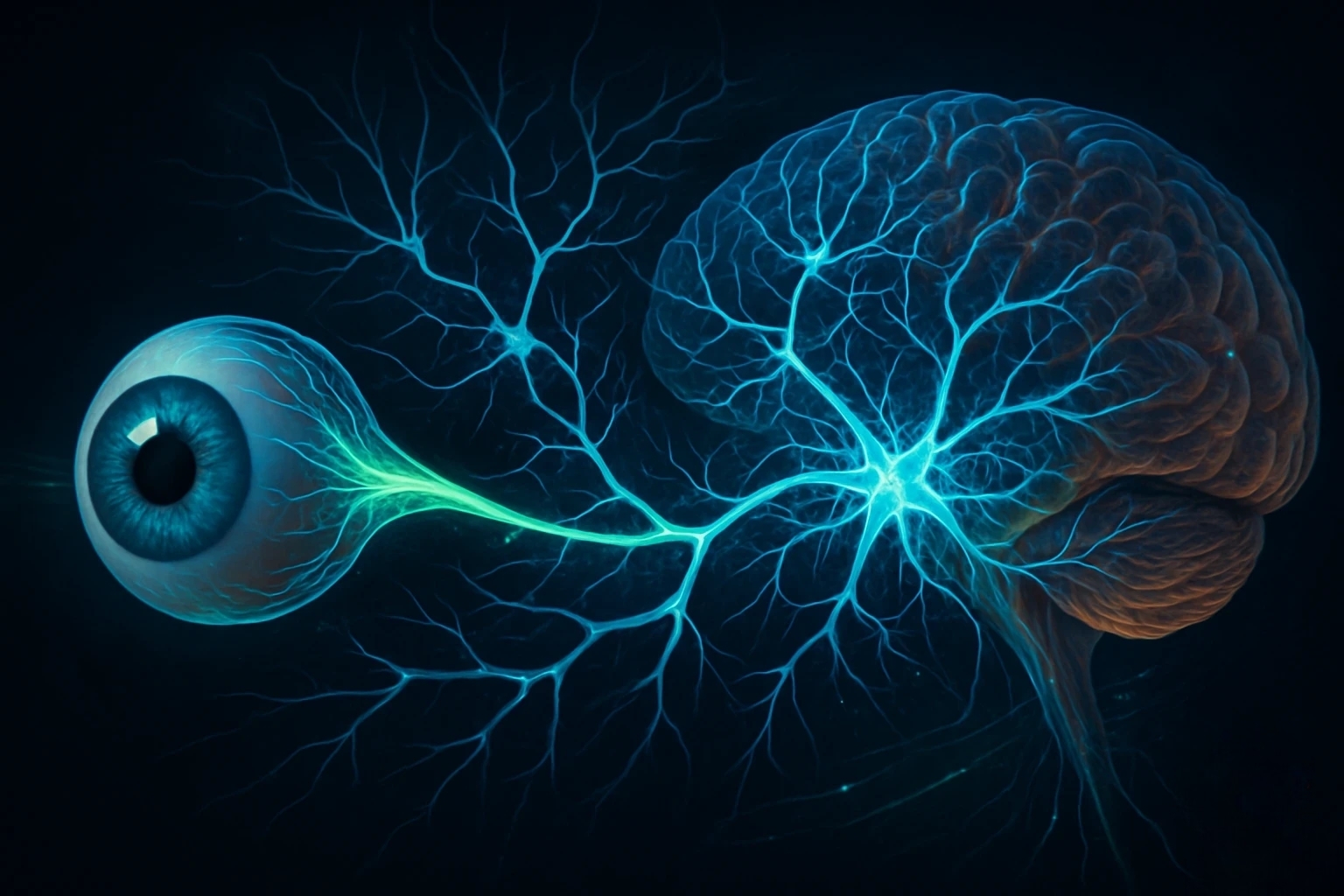
The eyes may still function normally
Light enters the eye
Signals reach the brain
Yet the person cannot see.
This condition is called cortical blindness.
It proves that vision is created in the brain, not the eyes.
The Brain Recognizes What You See
Your eyes can detect shapes and colors, but they cannot recognize objects.
Recognition happens in the brain.
For example, when you look at a face, your brain quickly identifies:
Facial features
Emotions
Identity
Familiarity
Special brain areas, such as the fusiform face area, are dedicated to recognizing faces.
How the Brain Fills Missing Information
Vision Is Not a Perfect Recording
Your brain does not simply display raw visual data.
Instead, it fills in missing pieces using past experiences and expectations.
This is why:
You can read messy handwriting
You recognize objects even when partially hidden
You see complete shapes even when parts are missing
Your brain constantly predicts and reconstructs reality.
The Brain Predicts What You Will See
Scientists believe vision works partly through prediction.
The brain:
Uses previous knowledge.
Predicts what it expects to see.
Confirms or corrects those predictions using visual input.
This process helps you recognize objects in a fraction of a second.
Why Optical Illusions Trick Your Brain
Optical illusions provide powerful evidence that vision happens in the brain.
If the eyes alone were responsible for seeing, illusions would not exist.
Instead, illusions occur because the brain misinterprets visual signals.
Famous Types of Visual Illusions
Size Illusions
Objects appear larger or smaller depending on surrounding shapes.
Motion Illusions
Still images appear to move.
Color Illusions
Colors appear different depending on background lighting.
Depth Illusions
Flat images appear three-dimensional.
These illusions reveal that the brain is constantly interpreting information rather than recording it perfectly.
The Brain Sees Things That Are Not There
Your brain sometimes creates visual experiences even without real visual input.
Examples include:
Dreams
Hallucinations
Imagination
Visual memories
During dreams, the brain generates vivid images even though the eyes are closed.
This proves that the brain alone can create visual experiences.
How Fast Your Brain Processes Visual Information
The human brain processes visual information incredibly quickly.
Research suggests:
The brain can recognize images in as little as 13 milliseconds.
Visual signals travel from the eye to the brain in less than a tenth of a second.
This speed allows humans to:
React to danger quickly
Recognize faces instantly
Navigate complex environments
Vision Is a Team Effort Between Eyes and Brain
Although the brain does the interpretation, the eyes still play a crucial role.
The Eyes Provide
Light detection
Focus adjustment
Color sensing
Initial signal creation
The Brain Provides
Image interpretation
Object recognition
Spatial awareness
Meaning and context
Without either system, vision would be impossible.
Surprising Facts About Human Vision
Here are some fascinating facts about how humans actually see:
Your brain flips the upside-down image from the retina.
Each eye sends slightly different images to the brain.
The brain merges both images to create depth perception.
You blink about 15–20 times per minute, yet the brain hides the darkness.
The brain ignores unnecessary visual details to save energy.
These hidden processes happen every second of your life without you noticing.
Why Understanding Brain Vision Matters
Studying how the brain creates vision helps scientists:
Treat blindness and vision disorders
Develop artificial vision technologies
Improve brain–computer interfaces
Build smarter AI vision systems
Understand neurological diseases
Fields such as neuroscience, psychology, and artificial intelligence all study this powerful system.
The Future of Vision Science
Researchers are making incredible breakthroughs in vision technology.
Some exciting developments include:
Artificial Vision Implants
Devices that can restore limited vision to blind individuals.
Brain–Computer Interfaces
Technology that may allow visual signals to bypass damaged eyes.
AI Vision Systems
Machines that learn to interpret images similar to the human brain.
Neural Prosthetics
Future devices may directly stimulate the brain to create visual experiences.
These innovations could transform the lives of millions of people.
Conclusion
The idea that we see with our eyes is only partially true. While the eyes capture light and send signals, the real experience of seeing happens inside the brain.
Your brain analyzes millions of pieces of visual information every second—detecting shapes, colors, movement, and meaning. It fills in missing gaps, predicts patterns, and even creates visual experiences during dreams.
In reality, your eyes are simply the sensors, while your brain acts as the ultimate visual processor.
Understanding this remarkable partnership reveals just how extraordinary the human body truly is.
The next time you look at the world around you, remember:
you are not just seeing with your eyes—you are seeing with your brain.

You must be logged in to post a comment.