

Artificial Intelligence (AI) has become one of the most powerful technologies in the modern world. In 2026, AI is changing how people work, learn, communicate, run businesses, and manage their daily activities. What once seemed like science fiction is now part of everyday life.
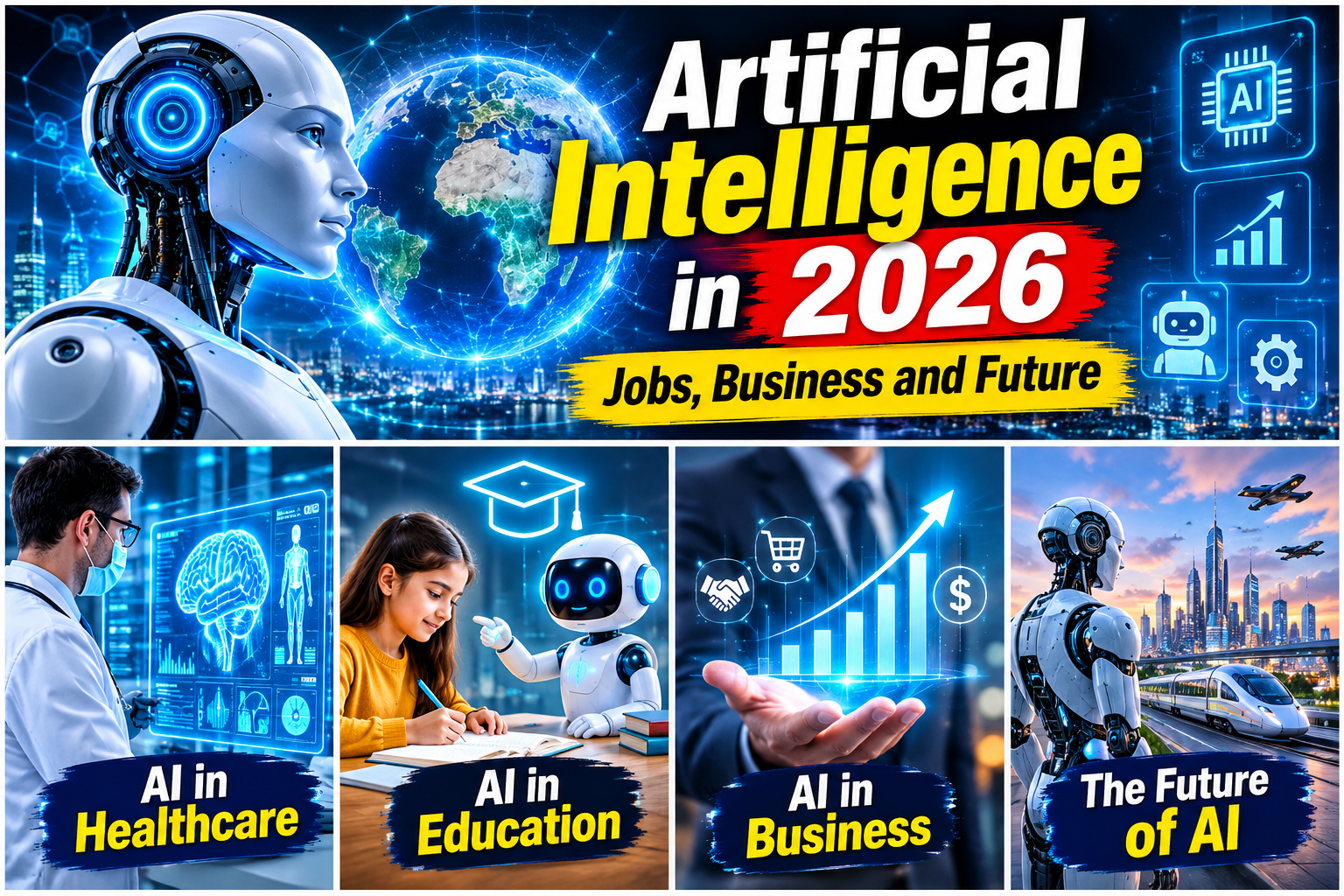
From AI-powered chatbots and smart assistants to advanced medical systems and automated business tools, artificial intelligence is creating opportunities across almost every industry.
Millions of people are already using AI to save time, improve productivity, create digital content, and solve complex problems. However, this technology also raises important questions about employment, privacy, security, and the future of human creativity.
In this article, we will explore how artificial intelligence is transforming the world, its major benefits, possible risks, and the opportunities it may create in the coming years.
1. What Is Artificial Intelligence?
Artificial Intelligence is a branch of computer science that focuses on developing machines and software capable of performing tasks that normally require human intelligence.
These tasks include understanding language, recognizing images, analyzing information, solving problems, and making predictions.
For example, when someone asks an AI chatbot a question and receives an answer within seconds, artificial intelligence is being used to process that request.
AI systems work with data and algorithms. Some advanced systems can learn patterns from large amounts of information and use those patterns to produce useful results.
Today, artificial intelligence is used in smartphones, search engines, online shopping platforms, banking services, healthcare systems, and many other industries.
2. How Artificial Intelligence Is Changing Businesses
Businesses are among the biggest users of artificial intelligence.
Companies use AI to improve customer service, understand market trends, organize information, and reduce repetitive work.
For example, online stores can use AI-powered systems to recommend products based on customers' interests and previous shopping activities.
Businesses can also use AI chatbots to answer common customer questions at any time of the day.
Another important application is data analysis. Instead of manually examining thousands of records, companies can use AI tools to identify patterns and generate useful reports.
Small businesses can benefit from these technologies too. A small business owner may use AI to prepare marketing ideas, write product descriptions, organize business information, and create social media content.
However, businesses should always check AI-generated information because automated systems can sometimes produce incorrect results.
3. Artificial Intelligence and Online Earning Opportunities
One reason artificial intelligence has attracted so much attention is its potential to create new online earning opportunities.
People with digital skills can use AI tools to improve their work and offer services to clients around the world.
Some possible opportunities include:
AI-Assisted Content Writing: Freelancers can use AI tools to research topics, develop outlines, and improve written content. High-quality articles still require human editing, fact-checking, and originality.
Graphic Design: AI image-generation tools can help creators develop visual concepts, illustrations, and marketing materials.
Video Editing: AI-powered editing software can assist with subtitles, background removal, audio cleanup, and other editing tasks.
Digital Marketing: Businesses can use AI to generate marketing ideas, prepare advertising content, and analyze campaign performance.
Translation Services: AI can help translate information between languages, although professional review remains important for accuracy and natural language.
People should understand that AI does not automatically generate income. Success depends on developing useful skills, providing quality services, finding customers, and building trust.
4. The Impact of AI on Jobs and Employment
One of the most discussed questions about artificial intelligence is whether it will replace human workers.
The answer is not simple.
AI can automate certain repetitive tasks, including data entry, basic customer support, document processing, and some administrative activities.
This may reduce the need for human involvement in particular tasks. However, it can also create demand for new types of work.
For example, organizations need people who can develop AI systems, manage digital projects, analyze information, protect computer networks, and evaluate automated results.
Human skills such as communication, creativity, leadership, critical thinking, and emotional understanding will remain valuable.
Instead of competing directly with technology, workers can learn to use AI as a tool to improve their productivity.
People who continuously develop their skills may be better prepared for changes in the employment market.
5. How AI Is Transforming Education
Artificial intelligence is creating new possibilities for students and teachers.
Students can use AI-powered learning assistants to understand difficult concepts, practice mathematics, improve grammar, and learn foreign languages.
For example, a student who struggles with a science topic can ask an AI assistant to explain it using simple language and practical examples.
Teachers can also use AI to prepare lesson plans, generate practice questions, organize educational material, and support different learning needs.
AI may make education more accessible for people who cannot easily access private tutoring or expensive educational resources.
However, students should not depend entirely on AI to complete their assignments.
Learning requires personal understanding, independent thinking, research, and practical experience.
AI should support education rather than replace the learning process.
6. Artificial Intelligence in Healthcare
Healthcare is another important field where artificial intelligence is being explored and adopted.
AI systems can help medical professionals examine medical images, organize patient information, identify patterns, and support scientific research.
For example, certain AI systems can assist trained specialists in reviewing X-rays, scans, and other medical images.
Researchers are also exploring how AI can help accelerate the discovery of medicines and improve the analysis of medical data.
These developments may support faster research and more efficient healthcare services.
However, AI systems are not perfect. They can make mistakes, and their results may be incomplete or inaccurate.
Doctors and other qualified healthcare professionals must remain responsible for medical decisions.
Patient privacy and the secure handling of medical information are also essential.
7. The Role of AI in Everyday Life
Many people use artificial intelligence without even realizing it.
When a smartphone recognizes a face, a navigation application suggests a faster route, or a streaming platform recommends a movie, AI may be involved.
AI-powered assistants can also help users organize schedules, search for information, write messages, and manage everyday tasks.
Online shopping platforms use recommendation systems to suggest products that may interest customers.
Email services can identify suspicious messages and filter unwanted spam.
These examples show that artificial intelligence is not limited to scientists or technology companies. It is becoming part of ordinary daily activities.
8. The Biggest Risks and Challenges of Artificial Intelligence
Although AI offers many benefits, it also introduces serious challenges.
Fake Images and Videos: AI tools can generate realistic images, voices, and videos. These technologies may be misused to spread misinformation or deceive people.
Privacy Concerns: Some AI services process personal information. Users should understand what information they share and review privacy settings.
Incorrect Information: AI can sometimes generate answers that sound convincing but contain mistakes. Important information should always be verified through reliable sources.
Cybersecurity Threats: Criminals may misuse AI to create convincing scam messages, impersonate people, or support other online attacks.
Employment Changes: Automation may affect certain occupations, creating pressure on workers to develop new skills.
Governments, technology companies, businesses, and individuals all have a role in encouraging responsible AI development and use.
9. Popular AI Tools People Can Explore in 2026
Several AI-powered platforms are available for different purposes.
ChatGPT: Can assist with writing, learning, brainstorming, research support, and everyday questions.
Google Gemini: Offers AI assistance for information-related tasks, writing, and productivity.
Microsoft Copilot: Helps users with various productivity and AI-assisted tasks.
Canva AI: Provides tools that can assist with graphic design and content creation.
Grammarly: Helps users improve grammar, spelling, clarity, and writing style.
Adobe Firefly: Offers AI-powered creative tools for image and design workflows.
Each platform has different features, pricing options, and limitations. Users should compare available plans and choose tools that match their requirements.
10. How to Prepare for an AI-Powered Future
Artificial intelligence is developing rapidly, and learning how to use it effectively can be valuable.
Here are some practical steps:
Learn basic digital skills and become comfortable using modern technology.
Explore AI tools that are relevant to your profession or interests.
Improve communication, writing, and problem-solving abilities.
Learn how to verify information instead of accepting every AI-generated answer.
Understand basic online privacy and cybersecurity practices.
Build practical experience by completing real projects.
The goal should not be to depend completely on AI. Instead, people should combine technological tools with human knowledge, creativity, and judgment.
11. What Does the Future of Artificial Intelligence Look Like?
The future of artificial intelligence may bring major changes to science, transportation, manufacturing, education, and healthcare.
AI systems may become more capable of understanding complex instructions and assisting with multiple tasks.
Robotics may also become more advanced, allowing machines to perform a wider range of physical activities in controlled environments.
In scientific research, AI could help researchers analyze large datasets and investigate complicated problems.
However, predicting exactly how these technologies will develop is difficult.
Their future impact will depend on technological progress, public policies, safety standards, economic conditions, and how society chooses to use them.
One thing is clear: people and organizations will need to adapt as digital technologies continue to evolve.
Conclusion
Artificial Intelligence is transforming the modern world in ways that were difficult to imagine just a few years ago.
It is changing businesses, creating new possibilities for online work, supporting education, assisting healthcare professionals, and making everyday digital services more intelligent.
At the same time, AI brings challenges involving privacy, misinformation, cybersecurity, and employment.
The most important approach is to use artificial intelligence responsibly while continuing to develop human skills.
People who understand this technology and learn how to work alongside it may be better prepared for future opportunities.
Artificial intelligence is not simply a technological trend. It is an important development that will influence how society works, learns, and communicates in the years ahead.
What do you think about artificial intelligence? Will AI create more job opportunities in the future, or will it replace many traditional jobs? Share your opinion in the comments.









Comments 0
Sign in to join the conversation.
No comments yet. Be the first to say something.