

AI tools are the most useful study aid available to students today, and also the most misused. The students getting real value use them to understand material faster. The students wasting time use them to avoid understanding it at all.
The difference is not which tool you use. It is what you ask it to do.
How to Use AI Without Cheating Yourself
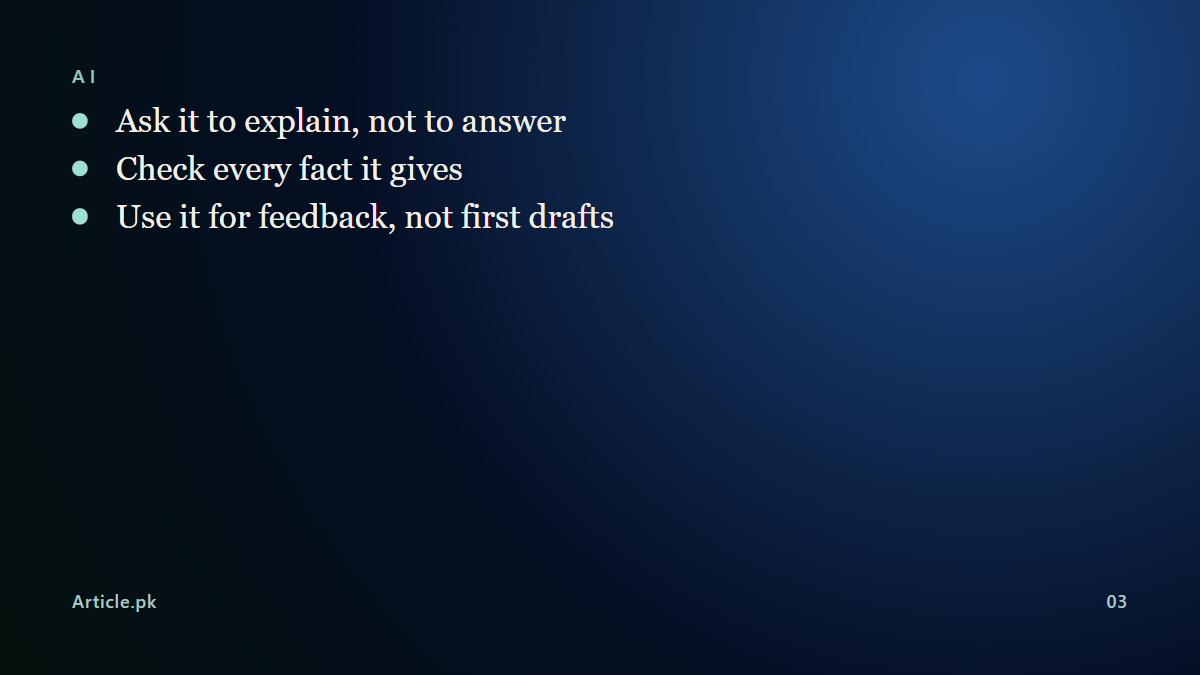
The rule is simple: AI should make you think more, not less. If you use it to generate an essay, you have learned nothing and produced something detectable. If you use it to explain a concept you do not understand, to quiz you on material, or to critique your draft, you have learned faster.
The second rule is verification. AI invents facts with total confidence. Every factual claim it makes needs checking against a source you trust.
The Top 10 Tools
1. A General Chat Assistant
Use it as a tutor, not an answer machine. Ask it to explain a concept at three levels of difficulty. Ask it to give you an example and then ask you to solve a similar problem. The Socratic mode, where it asks you questions instead of answering them, is the most effective way to use it for learning.
Give it your rough thinking, not your polished question. It is more useful as a thinking partner.
2. A Research Assistant With Sources
Tools that search the web and return answers with links are worth more than tools that answer from memory, because you can check them. Use them to map a topic fast, then read the two best sources yourself.
Never cite a source you have not opened.
3. A Document Summariser
Feed it a long paper and ask for the argument, the evidence, and the gaps. This is where AI genuinely outperforms skimming, because it does not get tired at page thirty.
Always ask for page references so you can verify.
4. A Flashcard Generator
Turn your notes into flashcards automatically, then study them with spaced repetition. The generation saves hours; the studying is still yours.
Check the generated cards for accuracy before trusting them.
5. A Grammar and Style Tool
Use it on the final pass of your writing, never the first. It catches errors and suggests tighter phrasing without replacing your voice.
Turn off aggressive suggestions if it starts flattening your style.
6. A Citation Manager
AI-assisted citation tools find sources, format references, and check for plagiarism. They save hours of manual work and reduce errors.
Verify every citation. AI sometimes invents sources that do not exist.
7. A Math and Equation Solver
Step-by-step solutions to problems, with explanations. The value is in the steps, not the answer. If you only read the answer, you have learned nothing.
Cover the answer and try the problem yourself first.
8. A Presentation Builder
Give it an outline and get a structured deck. The design is middling but it removes the blank-slide paralysis that eats an evening.
Spend your saved time on content, not layout.
9. A Transcription Tool
Record lectures and get searchable text. This is invaluable for revision and for students who struggle to take notes fast enough.
Always ask permission before recording a lecture.
10. A Study Planner
AI can generate a revision timetable from your syllabus and exam dates, with spaced repetition built in. It removes the planning burden and produces a more realistic schedule than most students make themselves.
Adjust it to your actual capacity, not your ambition.
The Mistakes That Waste Time
Using AI to write essays produces detectable, generic work and teaches you nothing. Using it to summarise without reading the source means you cannot answer questions about it. And trusting its facts without checking them is how students end up citing papers that do not exist.
The students who benefit most treat AI as a tutor that is available at midnight, not as a shortcut past the work.
How to Check AI Output
The verification habit is simple: for every factual claim, find a source. If the AI cites a paper, open it and confirm the claim appears. If it gives a date, check it. If it summarises a text, skim the original to confirm the summary is accurate.
This takes time, but it is less time than redoing an assignment that was marked down for fabricated sources.
Also check for bias. AI models reflect the biases in their training data, which means they can present a narrow or skewed view of contested topics. Ask for counterarguments explicitly.
And keep a record of what you asked and what you received. If a marker questions your work, you need to show how you used the tool and what you verified.
The Academic Integrity Question
Most institutions now have policies on AI use, and they vary widely. Some ban it entirely, some allow it with disclosure, some encourage it. Know your institution's policy before you use these tools, not after.
The general principle is that AI can assist your learning but cannot replace it. Using it to understand material is legitimate. Using it to produce work you submit as your own is not, regardless of the policy wording.
The line is not always clear, which is why disclosure is the safest approach. State what you used and how. A marker who knows you used AI as a tutor will judge your work differently from one who suspects you used it to write.
How to Get the Most From AI Feedback
The best use of AI for writing is not generation. It is critique. Write your draft first, then ask the AI to identify the weakest argument, the vaguest claim, and the sentence that could be cut. This is faster than asking a classmate and more honest than asking a friend.
Then revise based on the critique, and ask again. Two rounds of this produces a substantially better draft than one round of generation.
The same applies to code. Write it yourself, then ask for a review. The AI will catch bugs and suggest improvements you would not have thought of, and you will understand them because you wrote the original.
This is the difference between using AI to learn and using it to avoid learning. One produces a better student; the other produces a student who cannot work without it.
The Bottom Line
Use AI to understand faster, not to avoid understanding. Verify every fact, disclose your use, and let the learning be yours.






Comments 0
Sign in to join the conversation.
No comments yet. Be the first to say something.