

Introduction
Science is one of the most important parts of human life. It helps us understand the world, discover new things, and improve the way we live. From the moment we wake up until we go to sleep, science plays an important role in our daily activities. We use smartphones, computers, electricity, medicines, vehicles, and many other things that are possible because of scientific discoveries.
Science is not only about laboratories, experiments, and complicated formulas. It is also about observing nature, asking questions, finding answers, and solving problems. Throughout history, scientific knowledge has helped human beings move from simple lifestyles to a modern and advanced society.

1. What Is Science?
Science is the systematic study of the natural world through observation, experiments, research, and evidence. It helps people understand how things work and why certain events happen.
For example, science explains why the sun rises, how plants grow, why rain falls, and how the human body functions. Scientists investigate different questions and develop explanations based on facts and evidence.
Science encourages curiosity and critical thinking. It teaches people not to accept everything without understanding the reasons behind it.
2. The Role of Science in Everyday Life
Science has become an essential part of our everyday routine. We depend on scientific inventions for communication, transportation, education, cooking, cleaning, and entertainment.
Electricity allows us to use lights, fans, refrigerators, and other household appliances. Mobile phones help us communicate with people around the world. Washing machines make household activities easier, while modern transportation saves time and energy.
Even simple activities, such as drinking clean water or storing food in a refrigerator, involve scientific knowledge.
Without science, modern life would be much more difficult.
3. Science and Modern Technology
Technology is one of the greatest results of scientific development. Scientific discoveries have created opportunities for new inventions that have transformed the world.
Computers have changed the way people work, study, and communicate. The internet provides access to information within seconds. Artificial intelligence is helping businesses, schools, hospitals, and industries perform different tasks more efficiently.
Robots are also being used in factories, research laboratories, and healthcare facilities. These technologies reduce human effort and improve productivity.
However, technology should always be used responsibly. People must maintain a balance between digital activities and real-life responsibilities.
4. Importance of Science in Education
Science plays an important role in education because it develops knowledge, creativity, and problem-solving skills.
Students learn about physics, chemistry, biology, environmental science, and other scientific subjects. These subjects help them understand the natural world and develop logical thinking.
Science education also encourages students to conduct experiments, ask questions, and discover new ideas.
Modern educational institutions use digital boards, computers, online learning platforms, and educational applications to improve teaching methods.
When students understand science through practical activities, they become more interested in learning and exploring new possibilities.
5. Science in the Field of Medicine
Medical science has improved human health and increased life expectancy. In the past, many diseases were difficult to treat because people had limited medical knowledge and resources.
Today, doctors use advanced medical equipment, laboratory tests, medicines, and surgical techniques to diagnose and treat different illnesses.
Vaccines protect people against dangerous infectious diseases. Modern imaging technologies, such as X-rays, CT scans, and MRI scans, help doctors examine the human body.
Scientific research also supports the development of new medicines and treatments.
Medical science continues to create better opportunities for healthier lives.
6. Science and Environmental Protection
Science helps us understand environmental problems and find solutions to protect our planet.
Climate change, air pollution, water pollution, deforestation, and the loss of wildlife are serious challenges facing the world.
Environmental scientists study these problems and suggest ways to reduce their harmful effects.
Renewable energy sources, including solar, wind, and hydropower, provide alternatives to traditional fossil fuels. Recycling, water conservation, and tree plantation are also important activities that support environmental protection.
Scientific knowledge teaches people that protecting nature is essential for present and future generations.

7. Space Exploration and Scientific Discoveries
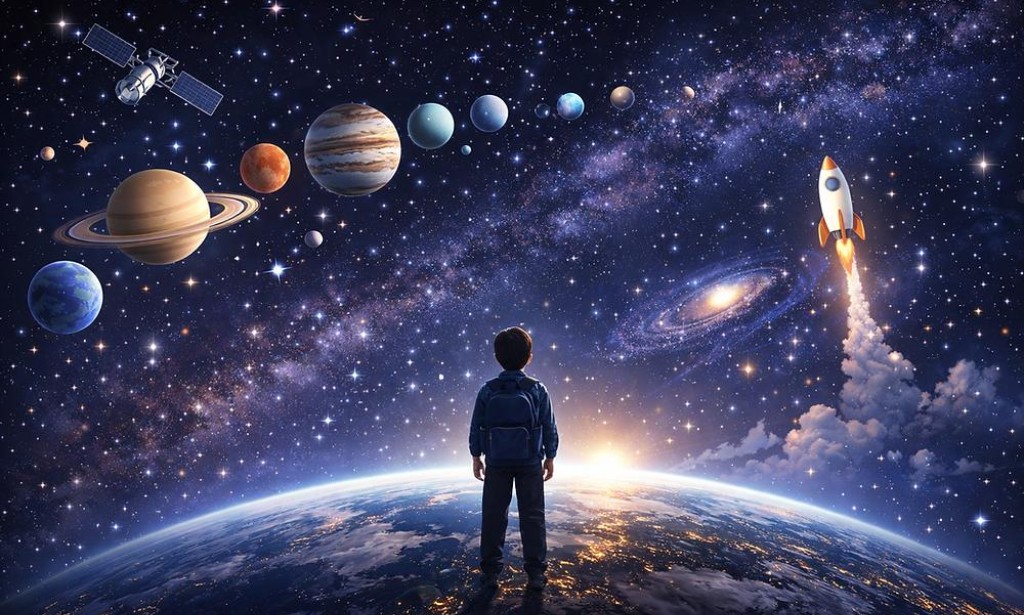
Space exploration is another exciting achievement of science. Scientists study planets, stars, galaxies, and other objects in the universe to understand how space works.
Satellites provide important services such as weather forecasting, communication, navigation, and environmental monitoring.
Space telescopes help researchers observe distant galaxies and discover new information about the universe.
Space missions have also increased our understanding of the Moon, Mars, and other planets.
These discoveries inspire young students to develop an interest in astronomy, physics, engineering, and scientific research.
8. The Importance of Scientific Research
Scientific research is necessary for discovering new knowledge and improving existing technologies.
Researchers investigate different problems, collect information, perform experiments, and study results before reaching conclusions.
Research in agriculture helps farmers improve crop production and develop better farming techniques. Research in medicine supports the discovery of new treatments. Similarly, technological research creates more efficient machines and communication systems.
Scientific progress depends on curiosity, patience, teamwork, and continuous learning.
Every major discovery begins with a question and the desire to find an answer.
9. Advantages of Science
Science offers many advantages that make human life easier, safer, and more comfortable.
Some major advantages include:
It improves healthcare and medical treatment.
It makes communication faster and easier.
It provides modern transportation facilities.
It supports education and online learning.
It improves agricultural production.
It helps people understand environmental problems.
It creates new employment opportunities.
It supports industrial and economic development.
These benefits demonstrate how scientific knowledge contributes to the progress of society.
10. Disadvantages and Challenges of Science
Although science has many benefits, its misuse can create serious problems.
Industrial activities may increase pollution, while excessive use of electronic devices can affect people's physical activities and daily routines.
Modern technologies can also create privacy and security challenges. Furthermore, some scientific developments, such as dangerous weapons, can threaten human life and global peace.
Another challenge is that not everyone has equal access to modern scientific facilities and technology.
Therefore, scientific knowledge should be used carefully and ethically. Governments, educational institutions, scientists, and individuals must work together to ensure that scientific progress benefits humanity.
11. The Future of Science
The future of science is full of possibilities. New discoveries in artificial intelligence, biotechnology, robotics, renewable energy, and space research may transform human life in the coming years.
Scientists are working to develop better medical treatments, improve food production, create cleaner energy sources, and solve environmental problems.
Artificial intelligence may help researchers analyze large amounts of information and discover solutions more quickly.
Future generations will play an important role in scientific development. Students who develop curiosity, creativity, and research skills today may become the scientists and inventors of tomorrow.
Conclusion
Science is a powerful tool that has transformed human civilization. It has improved healthcare, education, communication, transportation, agriculture, and technology. It helps people understand nature, solve problems, and discover new opportunities.
However, scientific knowledge must be used responsibly to protect humanity and the environment. The real purpose of science is not only to create new inventions but also to make the world a better place.
By promoting scientific education, research, and responsible innovation, we can build a healthier, safer, and more advanced future for everyone.







Comments 0
Sign in to join the conversation.
No comments yet. Be the first to say something.