
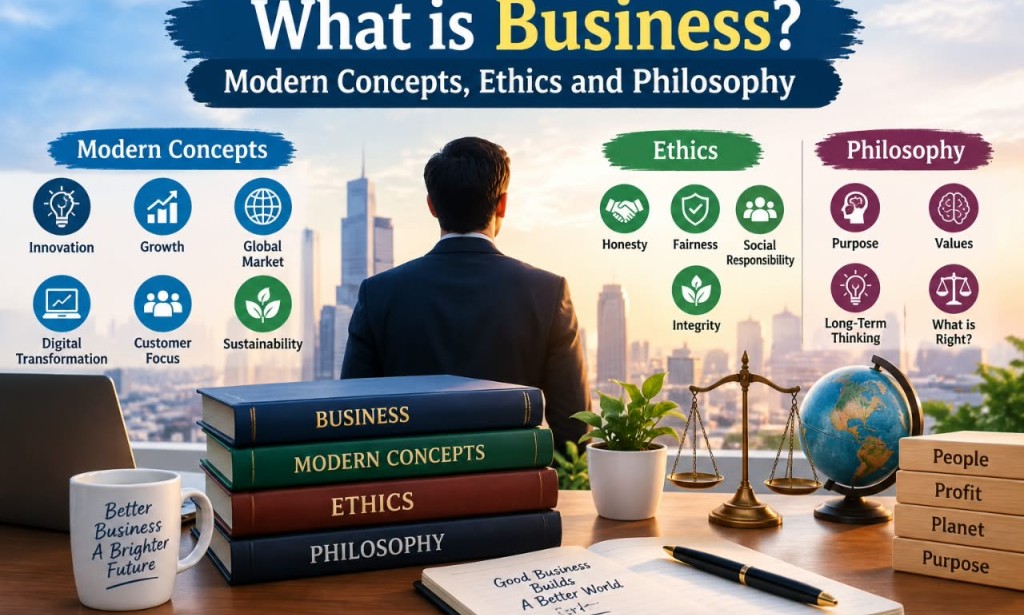
What is Business? A Conceptual, Economic, and Philosophical Analysis
Introduction
Since the dawn of human consciousness, individuals have continuously strived to fulfill their survival, developmental, and societal needs. In early human societies, survival requirements were basic—primarily centered around food, clothing, and shelter. These rudimentary needs were met through the barter system, where a farmer might exchange wheat for shoes from a cobbler, or a herder might trade milk for cloth. However, as human intellect, social structures, and civilization evolved, societal needs grew increasingly complex and multi-layered.
This evolutionary journey gave rise to a structured, systematic, scientific, and all-encompassing global framework that we define today as Business.
At its most elementary level, business refers to any commercial, industrial, or economic activity conducted with the primary objective of earning a financial profit. Yet, from a deeper, philosophical, and socio-economic standpoint, business is far more than the simple exchange of paper currency, commodities, or digital transactions. Business represents a vast, interconnected ecosystem of value creation, problem-solving, wealth distribution, innovation, and human cooperation that keeps the engine of human civilization continuously moving forward.
1. The Core Concept and Philosophical Foundations
From an organizational and managerial perspective, a business is an organized enterprise in which individuals or corporate entities systematically produce, market, sell, and distribute goods (physical products) or services (intangible solutions) to satisfy human wants in exchange for monetary value.
Philosophically, the concept of business relies entirely on two fundamental pillars:
Human Need or Problem: A challenge, inefficiency, desire, or unfulfilled necessity exists within society.
Solution and Value Creation: An entrepreneur or enterprise formulates a practical, reliable product or service to resolve that specific challenge.
If all human needs, desires, and problems were to instantly disappear from the world, the concept of business would naturally cease to exist. Therefore, business is a direct reflection of human limitation and interdependence—our absolute necessity to rely on one another's specialized skills, physical labor, intellect, and resources.
2. Business Philosophy and the Wisdom of Ghani Khan
Business is not merely an exercise in accumulating material wealth; it is the ultimate expression of human effort, labor, and active engagement with the world. Ghani Khan (1914–1996), the famous Pashto philosopher, poet, artist, and intellectual, captured the core essence of hard work, self-reliance, and human action in his iconic Pashto poetry:
ادم چی حاورہ کہی کینی نو ثہ زرعون کی
منجلہ چی پہ دولت شی نو حامار شی
English Translation:
"
“A man may live without wealth, but he cannot live with dignity if he becomes a slave to money.”
🏤
"When a hand grasps easy wealth without effort, it becomes intoxicated and idle!"
Analytical Explanation in the Context of Business:
Ghani Khan’s poetry presents a profound philosophy of active exertion, production, and ethical enterprise.
The Necessity of Labor and Initiative: The first line emphasizes that growth, prosperity, and innovation ("making things grow") cannot occur through passive wishing. In business, an entrepreneur must "move their arms"—meaning they must take calculated risks, organize capital, execute strategies, and put in relentless effort. Without active exertion, no enterprise can produce value or yield results.
The Danger of Unearned Wealth: The second line warns against wealth that comes without effort or value creation. When money or power is acquired without active labor or meaningful contribution, it leads to lethargy, arrogance, and ultimate decline ("intoxication"). True business is rooted in legitimate value creation rather than passive exploitation or unearned gain.
Ghani Khan reminds us that continuous physical and mental effort is the foundational engine of all economic progress.
3. Main Pillars and Categorization of Business
To understand the expansive nature of modern business, it is helpful to divide it into three primary structural sectors:
Industry (Production Sector): This sector focuses on converting raw materials and natural resources into finished, usable commodities. It represents the manufacturing and processing stage—such as extracting iron ore to manufacture automobiles, or harvesting raw cotton to produce textiles.
Commerce and Trade (Distribution Sector): Commerce acts as the critical bridge connecting the manufacturer (producer) to the end consumer. It encompasses wholesale and retail trade, along with essential support services including logistics, transportation, banking, warehousing, and commercial insurance.
Services Sector (Knowledge & Solutions): In the contemporary world, business extends far beyond physical goods. Education, healthcare, information technology (IT), tourism, financial consulting, and legal advisory services constitute the largest and fastest-growing segment of the modern global economy.
4. Key Components of a Sustainable Business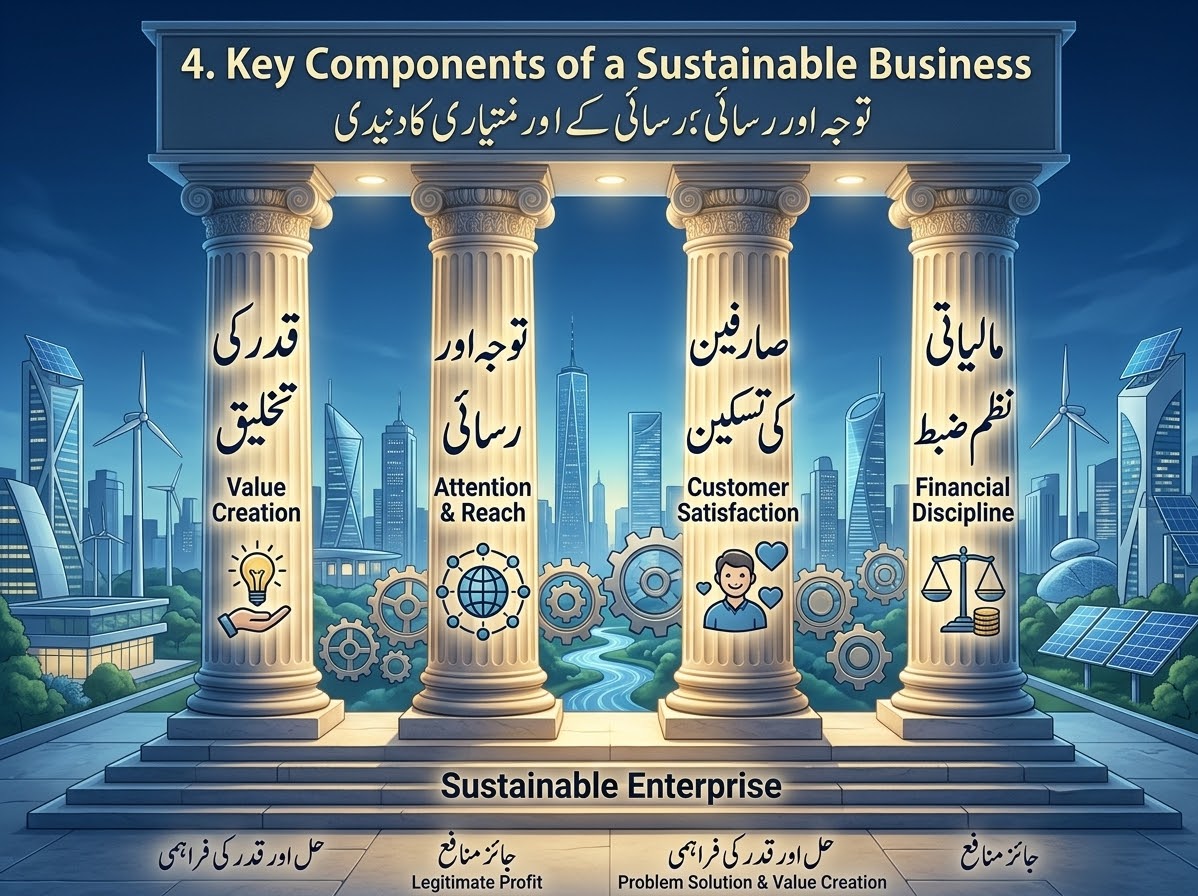
Millions of business ventures are launched around the globe every year, but only those built on sound, ethical, and strategic fundamentals survive over the long term. A sustainable enterprise stands firmly on four core pillars:
Value Creation: Offering a product or service that genuinely solves a real-world problem or enhances the quality of human life.
Customer Satisfaction & Trust: A business exists to serve its consumers. Long-term commercial success relies on building transparent, ethical relationships and maintaining uncompromising quality.
Risk Management & Adaptability: Economic landscapes are inherently uncertain. Visionary entrepreneurs anticipate market shifts, embrace emerging technologies, and pivot their strategies proactively.
Financial Discipline: Maintaining a healthy cash flow, balancing expenses with revenue, and reinvesting profits into research and development are vital for organizational longevity.
5. The Societal and Economic Impact of Business
Business is not an isolated activity; it serves as the primary engine driving economic, social, and technological advancement across societies:
A) Job Creation and Wealth Distribution
By creating enterprises, business leaders generate employment opportunities for millions of individuals. This enables families to earn a dignified livelihood, access better healthcare and education, and raise their overall standard of living.
B) Driving Innovation and Technological Progress
Healthy market competition forces businesses to continually innovate. The historical transition from horse-drawn carriages to electric vehicles, and from mechanical abacus devices to modern Artificial Intelligence (AI), has been largely propelled by commercial research, development, and market demand.
C) Fostering Global Integration
International trade connects nations across borders, building diplomatic, cultural, and economic ties. Countries that engage in robust bilateral trade foster peaceful relations and mutual dependence, reducing global conflicts.
6. Business Ethics and Corporate Social Responsibility (CSR)
When business operates strictly around the reckless pursuit of "profit at any cost," it results in social exploitation, environmental degradation, fraud, and economic inequality. Therefore, enduring businesses prioritize ethical standards and moral responsibility.
Universal ethical principles dictate that:
Integrity, honesty, fair trade practices, environmental stewardship, and empathy toward employees and consumers form the true soul of sustainable commerce.
Under the framework of Corporate Social Responsibility (CSR), modern organizations are expected to reinvest a meaningful portion of their profits into community development, environmental protection, public health, and educational initiatives. A business that ignores the well-being of its surrounding community eventually loses its social license to operate.
7. Key Components of a Sustainable Business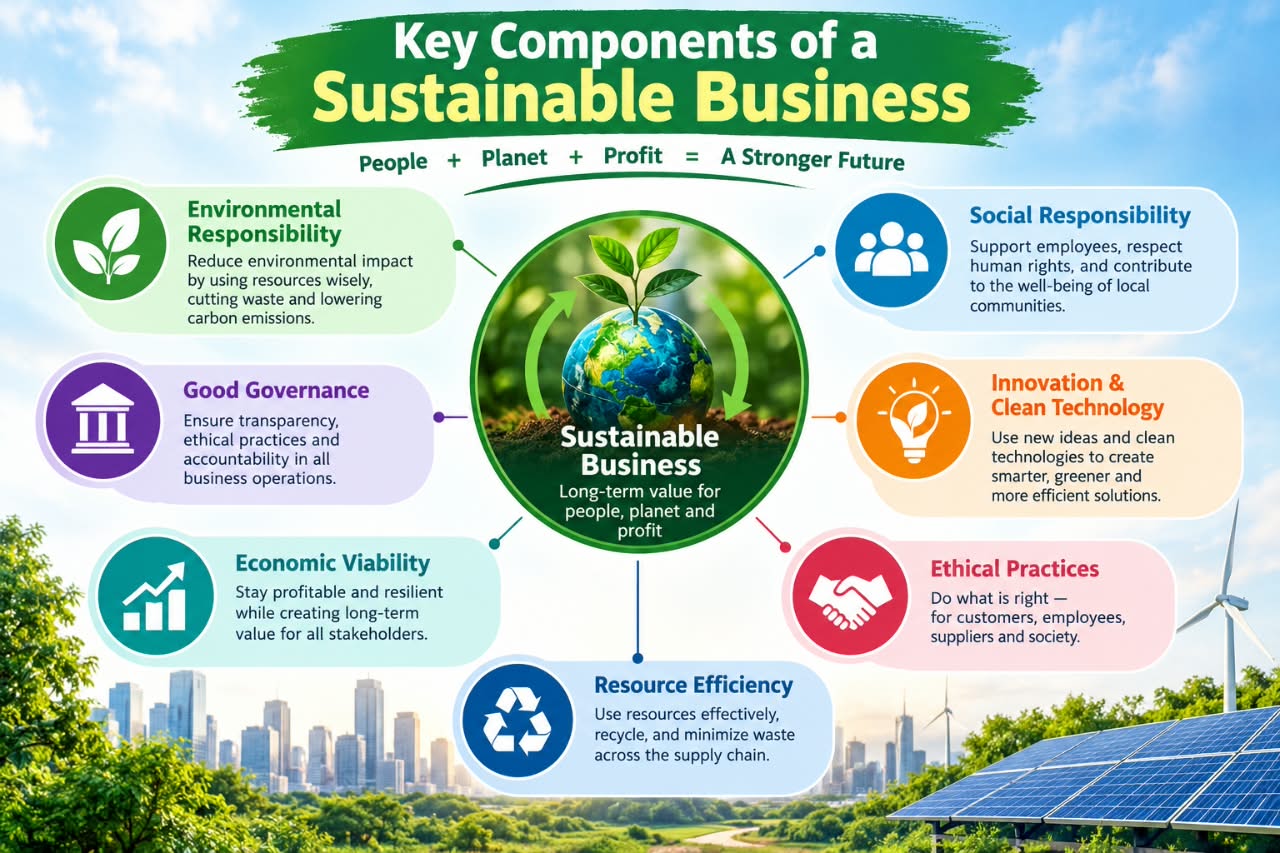
The 21st century has redefined traditional business paradigms through unprecedented technological advancements:
E-Commerce & Globalization: Physical storefronts are no longer a mandatory prerequisite for commerce. An entrepreneur can operate a global brand from a home office using internet platforms, reaching customers worldwide.
The Knowledge Economy: Digital products, cloud software, content creation, data analytics, and digital platforms have emerged as major economic powerhouses.
Data & Artificial Intelligence: Data has become the new fuel for modern business strategies. Companies leverage advanced AI algorithms to understand consumer behavior, optimize supply chains, and automate operations with high precision.
Conclusion
Ultimately, business is a profound testament to human ingenuity, strategic collaboration, relentless effort, and enterprise. It is far more than a numerical calculation of profit and loss; it is a dynamic mechanism designed to solve complex human challenges, enhance living standards, and drive civilization forward.
As expressed in the poetry of Ghani Khan, prosperity cannot bloom without active human exertion ("moving one's arms"). A truly impactful business leader builds more than financial capital—they channel human labor, spark innovation, create opportunities, elevate communities, and contribute meaningfully toward building a better, more prosperous world.

You must be logged in to post a comment.