

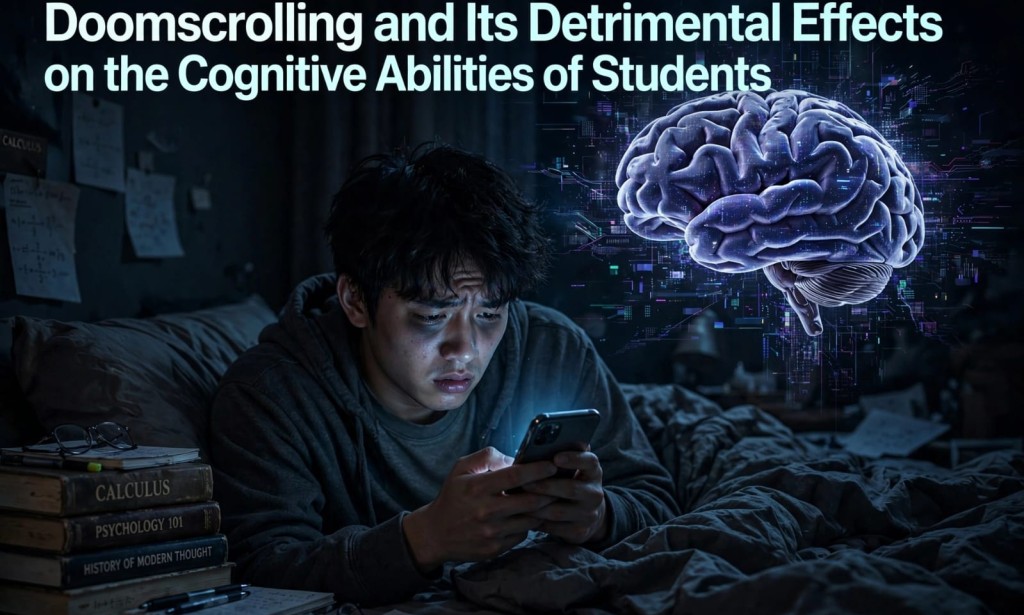
What is Doomscrolling?
In the quiet of midnight, when textbooks lie open and assignments await completion, a different kind of light glows in student dormitories. It is the blue light of a smartphone, and the thumb moving over it is not turning pages, but scrolling endlessly through a torrent of bad news, alarming headlines, social conflicts, and anxiety-inducing content. This phenomenon has a name: doomscrolling. Coined during the pandemic, it refers to the compulsive habit of spending excessive time scrolling through negative news, even though it makes the viewer feel worse. For students, who are at the peak of their cognitive development and academic pressure, this habit is not just a distraction; it is a direct assault on their ability to think, learn, and succeed.
*What Exactly is Doomscrolling?*
Doomscrolling is more than just using social media. It is a psychological loop. The brain is wired to pay more attention to threats — a survival mechanism known as negativity bias. Social media algorithms exploit this bias. They learn that you stopped to read about a crisis, a war, or a tragedy, and they feed you more of it to keep you engaged. For a student, it starts innocently: checking one notification before studying. An hour later, they have consumed dozens of distressing stories, from climate disasters to political unrest, without any resolution. They feel anxious, guilty for wasting time, yet unable to stop.
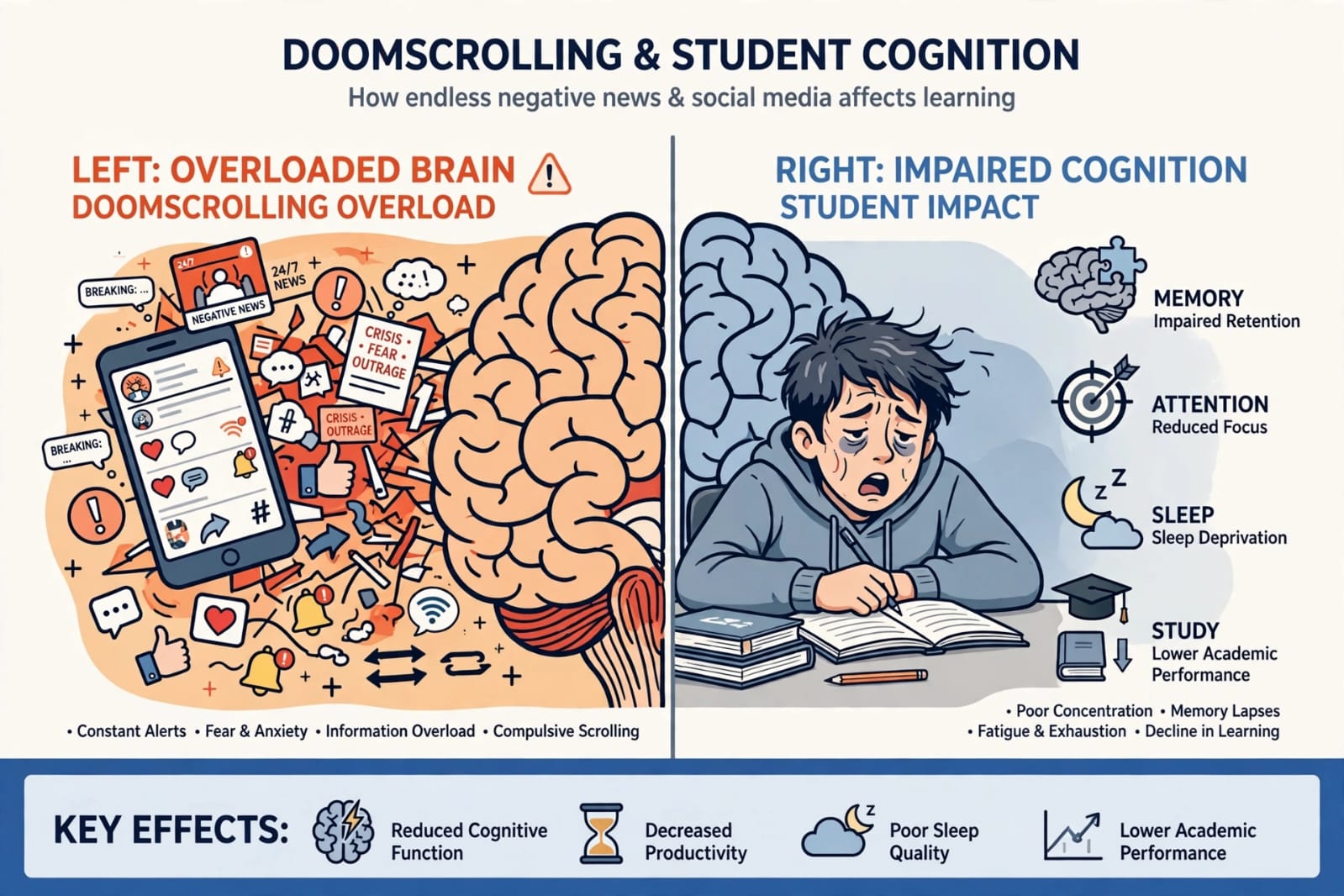
*The Cognitive Price: How the Brain Suffers*
Cognitive abilities are the mental processes that enable us to learn: attention, memory, reasoning, and problem-solving. Doomscrolling systematically erodes each one.
*1. The Collapse of Attention Span:*
Attention is like a muscle; it needs sustained focus to grow strong. Doomscrolling trains the brain for the opposite: rapid, shallow shifting. Each swipe delivers a new piece of information, a new dopamine hit. This conditions the brain to expect constant novelty. When a student then tries to read a 40-page academic chapter, the brain rebels. It craves the quick stimulation of the feed. Studies in cognitive psychology show that heavy media multitaskers perform poorly on sustained attention tasks. Students report an inability to read for more than 10 minutes without checking their phones, a classic symptom of an attention system fragmented by endless scrolling.
*2. Memory Impairment:*
Learning requires transferring information from short-term to long-term memory, a process that happens best during deep focus and quality sleep. Doomscrolling attacks both. First, the information overload creates cognitive clutter. The brain is flooded with irrelevant, emotionally charged data, leaving less working memory capacity for academic concepts. You cannot remember the Krebs cycle if your working memory is full of ten different news crises. Second, and more critically, doomscrolling destroys sleep. The blue light suppresses melatonin, and the emotional arousal from negative news keeps the mind hyperactive. Memory consolidation occurs during deep sleep. When students sacrifice sleep to scroll, they are literally erasing what they studied that day.
*3. Erosion of Critical Thinking and Decision Fatigue:*
Doomscrolling presents a world that is constantly in crisis, often in black-and-white, emotionally charged terms. This exposure reduces the ability to think critically and nuance. Students become mentally exhausted. Psychologists call this decision fatigue and information fatigue. After making hundreds of micro-decisions — whether to like, share, feel angry, feel sad — while scrolling, the brain has no energy left for complex academic decisions like analyzing a case study or structuring an essay. The result is intellectual apathy: students default to simpler, surface-level thinking because deep thinking feels too exhausting.
*4. Academic Performance and Productivity Loss:*
This is the final, measurable outcome. Research from the American Psychological Association has linked high levels of news-related anxiety and late-night screen time directly to lower GPAs. A student who doomscrolls for two hours before bed not only loses two hours of study and sleep but also enters the next day with a brain fog of anxiety and reduced motivation. Procrastination increases, deadlines are missed, and the quality of work drops because the brain is too tired to engage in higher-order thinking.
*Why Are Students So Vulnerable?*
Students are uniquely susceptible for three reasons. First, academic life itself is stressful, and doomscrolling is often a maladaptive coping mechanism — a way to avoid the stress of exams by engaging in the stress of the world. Second, their identity is still forming, making them more sensitive to social comparison and global issues. Third, they live in an environment of constant connectivity. University life blurs the line between work and leisure, and the phone is both a study tool and a source of endless distraction.
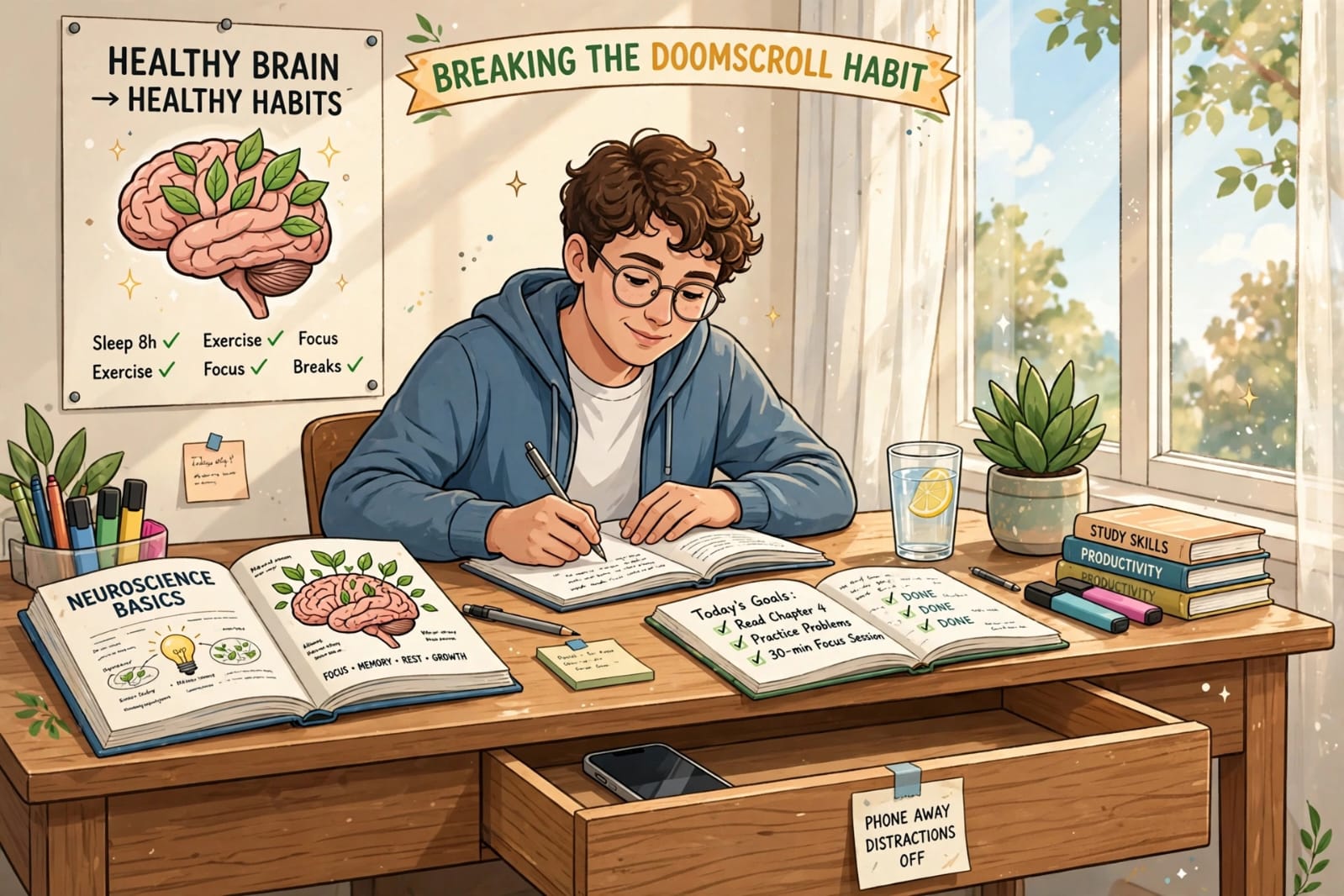
*Breaking the Cycle: From Awareness to Action*
The solution is not to abandon technology but to reclaim control over it. Digital discipline must be taught as a core academic skill.
First, practice time-blocking. Use techniques like the Pomodoro method: 50 minutes of focused study with the phone in another room, followed by a 10-minute intentional break. Use apps that block social media during study hours.
Second, curate your information diet. Instead of passively receiving an algorithmic feed, actively choose two or three reliable news sources and check them at fixed times — for example, 30 minutes in the morning and evening. Never use news as a pre-sleep activity.
Third, adopt a digital sunset. All screens off at least 60 minutes before sleep. Replace scrolling with journaling, reading a physical book, or planning the next day. This single habit can restore sleep quality and memory consolidation within a week.
Finally, replace the habit with a healthier loop. The urge to scroll often comes from anxiety. When you feel the urge, pause and ask: "What am I feeling? What do I actually need?" Often, you need a walk, water, or a conversation, not more information.
Conclusion
In conclusion, doomscrolling is the silent epidemic of the modern student. It promises awareness but delivers anxiety; it promises connection but creates cognitive disconnection. The screens will not get less addictive, and the news will not get less negative. Therefore, the responsibility falls on students to recognize that their attention is their most valuable academic resource. To protect it is not a luxury; it is a necessity for learning, mental health, and future success. The scroll is endless, but your cognitive capacity is not.






Comments 0
Sign in to join the conversation.
No comments yet. Be the first to say something.