


Good study habits can make learning easier, more organised, and less stressful. Many students spend hours reading textbooks but still struggle to remember important information. The reason is that studying for a long time does not always mean studying effectively. The way students organise their time, understand lessons, revise information, and prepare for exams can make a major difference.
Students in Pakistan and other countries often manage school, college, homework, family responsibilities, and personal activities. Without a simple routine, it can become difficult to complete everything on time. Fortunately, students do not need expensive equipment or complicated methods to improve their learning. They can begin with small changes, such as preparing a timetable, avoiding distractions, practising questions, and reviewing lessons regularly.
This guide explains how to improve study habits with practical techniques that students can use at home, in school, or while learning online.

1. Create a Realistic Study Timetable
A study timetable helps students organise their day and decide what to study first. Without a plan, students may spend too much time on one subject and forget about other important lessons.
Start by writing down your subjects and the topics you need to complete. Give more attention to subjects that you find difficult, but do not completely ignore the subjects you already understand.
For example, a student can study mathematics after school, review science later, and spend a short period practising English. The exact schedule should depend on school hours, homework, and personal responsibilities.
Keep your timetable realistic. You do not need to study every subject every day. Short, focused sessions with breaks can be more manageable than one extremely long session.

2. Study in a Quiet and Organised Place
Your study environment can affect how easily you concentrate. A noisy or untidy space may make it harder to focus on reading, writing, or solving questions.
Choose a place where you can sit comfortably and keep your books, notebooks, pens, and other materials nearby. If you share a room with family members, try to find a regular time when the environment is quieter.
Keep unnecessary items away from your study area. Put your phone aside when you do not need it for learning. If you use a phone or computer for schoolwork, close unrelated apps and notifications.
A perfect study room is not necessary. A clean desk, enough light, and a few basic supplies are often enough to create a useful learning space.
3. Use Active Learning Instead of Only Reading
Reading a chapter again and again may feel productive, but students should also practise remembering and explaining what they have learned.
One useful technique is active recall. After reading a small section, close the book and try to explain the main points in your own words. You can also write down questions and answer them without looking at your notes.
For example, after studying a science lesson, ask yourself:
- What are the main ideas?
- Can I explain this topic without reading?
- Which points do I still find confusing?
Another useful method is to solve practice questions. This helps you check your understanding and identify topics that need more attention.
Research reviews have discussed the benefits of retrieval practice and spacing study sessions over time. These methods can help learners remember information more effectively than relying only on repeated reading.
4. Revise Lessons Regularly
Waiting until the night before an examination to revise everything can make learning difficult. A better approach is to review information over several days.
After learning a new topic, spend a few minutes reviewing it later that day. Return to it again after a day or two, and then review it once more the following week.
You can use a simple revision plan:
- First review: On the day you learn the topic.
- Second review: One or two days later.
- Third review: About one week later.
- Final review: Before the class test or examination.
You may need to adjust this schedule depending on the difficulty of the subject. The important point is to avoid leaving all revision until the last moment.
5. Make Short and Useful Notes
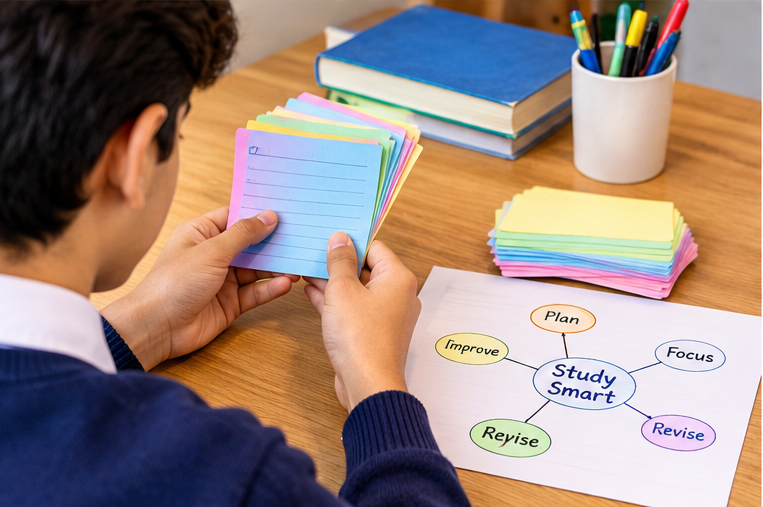
Good notes help students remember important information and revise more easily. However, copying every sentence from a textbook can take too much time.
Instead, write the main ideas using simple language. Use headings, short explanations, examples, and bullet points. Highlight only important terms rather than colouring every line.
For subjects such as science, diagrams can help explain processes. For mathematics, keep examples of important formulas and write down the steps used to solve questions.
You can also create flashcards. Write a question on one side and its answer on the other. Use them to test your memory during short revision sessions.
Your notes should help you understand the topic. They do not need to look perfect or contain every sentence from the textbook.
6. Manage Your Time and Avoid Distractions
Time management is an important part of effective studying. Students sometimes delay homework because they do not know where to begin or become distracted by entertainment and social media.
One simple method is to choose one task and work on it for a fixed period. For example, study mathematics for 25 minutes, take a short break, and then continue with another task if needed.
Before starting, decide exactly what you want to complete. Instead of writing "study science," write "read the chapter and answer five questions."
Keep your phone away during focused study sessions unless it is required for your lesson. You can check messages during planned breaks rather than interrupting every few minutes.
Remember that breaks are useful. A short walk, a drink of water, or a few minutes away from your desk can help you return to your work with better attention.
7. Ask Questions When You Do Not Understand
Students should not feel embarrassed about asking questions. Sometimes a topic becomes difficult because one basic idea has not been understood properly.
If you are confused, first read the explanation again and look at the examples. Then ask your teacher, classmate, or another trusted learning resource for help.
You can prepare specific questions before asking for assistance. For example, instead of saying "I do not understand mathematics," explain which step of a particular problem is confusing.
Online educational videos and learning materials can also provide another explanation of a topic. However, check whether the information matches your school syllabus and textbook.
Understanding a topic is more valuable than memorising an answer without knowing what it means.
8. Prepare for Exams Step by Step
Exam preparation becomes easier when students begin early and divide the syllabus into smaller sections.
First, check the examination date and list the chapters included in the syllabus. Mark the topics you understand well and the ones that need more practice.
Next, prepare a revision plan that gives enough time to each subject. Practise questions from textbooks, class exercises, and permitted past papers. After completing a practice test, check your mistakes and revise the relevant topics.
Do not spend all your preparation time reading. Writing answers, solving problems, and explaining concepts from memory can show whether you are ready.
Before an examination, prepare your required stationery and other materials. Follow your school's examination instructions and try to maintain a normal routine.

9. Take Care of Your General Well-Being
Effective learning is not only about books and notebooks. Students also need enough rest, regular meals, movement, and time for personal activities.
Try to maintain a consistent sleep routine so that you feel rested during school and study sessions. Drink water, eat regular balanced meals, and take breaks when needed.
Avoid comparing your progress with other students. Everyone has different responsibilities, learning needs, and strengths. Focus on improving your own understanding rather than trying to copy someone else's routine.
If your schedule becomes too difficult, adjust it. A sustainable study routine is more useful than a strict plan that you cannot follow.
10. Follow a Simple Seven-Day Study Improvement Plan
Students who want to improve their routine can begin with a simple seven-day plan.
Day 1: Organise your study area and list your subjects.
Day 2: Prepare a realistic timetable that fits your daily routine.
Day 3: Try active recall by closing your book and explaining a lesson from memory.
Day 4: Make short notes or flashcards for one difficult topic.
Day 5: Practise questions and check your mistakes.
Day 6: Review topics studied earlier in the week.
Day 7: Look at your progress and make small improvements to your timetable.
This plan is a starting point, not a strict rule. Repeat the activities that help you and adjust the schedule when schoolwork or family responsibilities change.
Frequently Asked Questions
1. How can students improve their study habits?
Students can improve their study habits by preparing a timetable, studying in an organised place, revising regularly, practising questions, and reducing distractions.
2. How many hours should a student study every day?
There is no single number that works for every student. Study time depends on age, school workload, subjects, and individual needs. Focus on completing planned tasks and understanding lessons rather than counting hours alone.
3. Is studying every day better than studying only before exams?
Regular study and revision help students spread learning over time. This can make it easier to remember information than trying to learn everything at the last minute.
4. What is active recall in studying?
Active recall is a learning method in which students try to remember information without immediately looking at their books. They can use questions, flashcards, or short written explanations.
5. How can students avoid distractions while studying?
Students can keep phones away when they are not needed, turn off unnecessary notifications, organise their study area, and work on one task at a time.
Conclusion
Improving study habits does not require a complicated routine. Students can make progress by organising their time, preparing useful notes, practising active recall, revising lessons regularly, and asking questions when they need help.
The most important step is to start with a few realistic changes and follow them consistently. A good study routine should support learning while leaving enough time for rest and other responsibilities.
Every student learns differently, so experiment with these methods and keep the ones that help you understand your subjects. With patience, regular practice, and a clear plan, students can become more organised and confident learners.







Comments 0
Sign in to join the conversation.
No comments yet. Be the first to say something.