

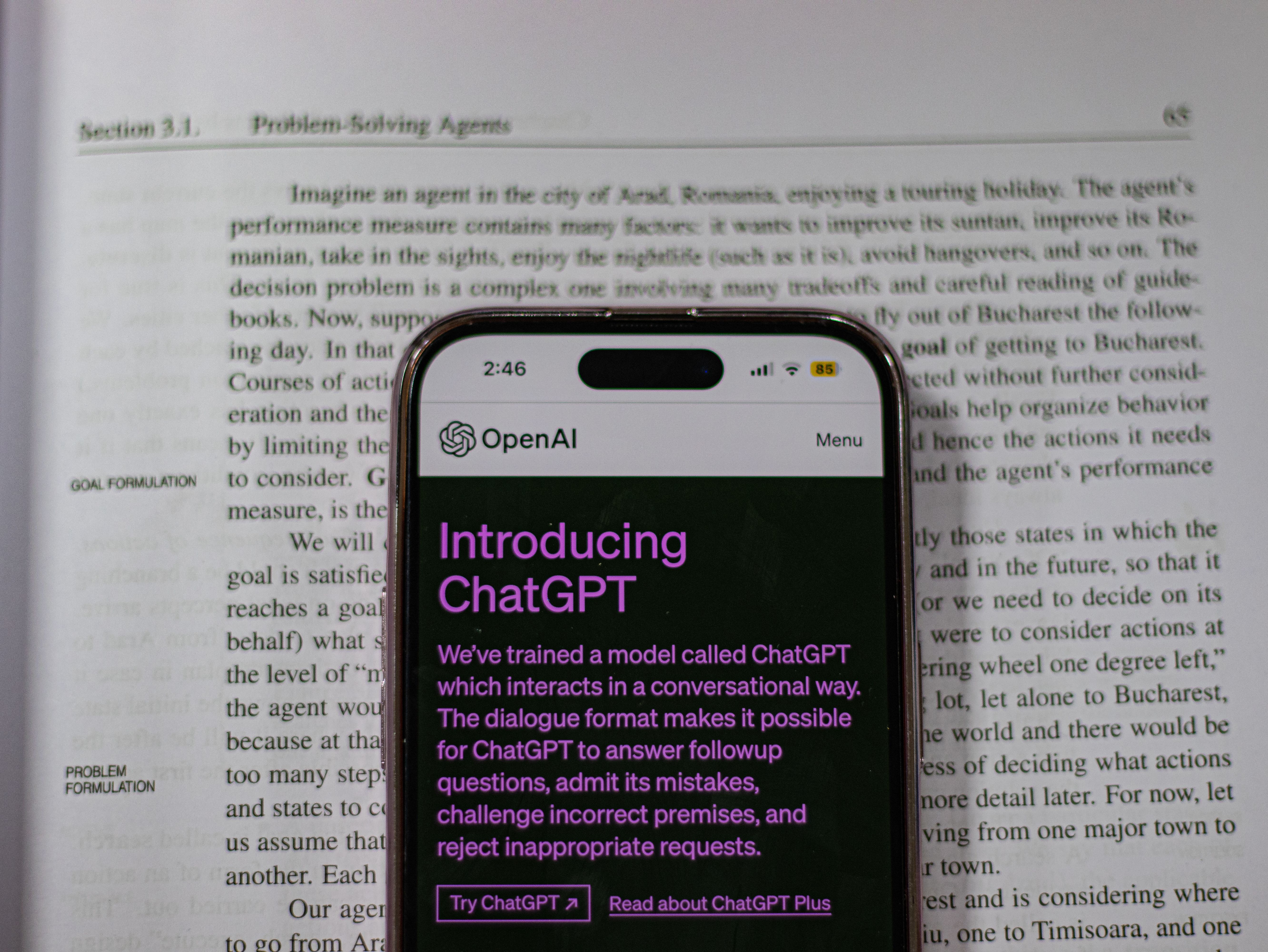
 Introduction: Are We Thinking Less?
 Artificial intelligence is changing how we learn, work, and think.
Think about the last time you needed an answer to a difficult question. Did you try to figure it out yourself, or did you immediately ask AI?
Artificial intelligence has become a part of our everyday lives. We use it to answer questions, understand difficult topics, write emails, generate ideas, and solve problems. Tasks that once took hours can now be completed in minutes. There is no doubt that this technology has made many things ea
 Technology makes information easier to access, but we must still think critically about what we see.
sier.
But there is another side to this convenience that deserves our attention. When answers are always available at the click of a button, do we still make enough effort to think for ourselves?
AI is not necessarily making people less intelligent. However, depending on it for every decision or problem could reduce the opportunities we have to practise independent thinking. The real question is not whether AI is good or bad, but whether we are learning to use it wisely.
How AI Is Making Our Lives Easier
Before discussing the problems, we should acknowledge the benefits of artificial intelligence. When used properly, it can be an incredibly useful tool.
For students, AI can explain complicated concepts in simpler language, generate practice questions, and help organize revision notes. Someone struggling with a difficult physics problem, for example, can ask AI to explain the underlying concept before attempting the question independently.
AI can also help people who are learning a new language, working on creative projects, or trying to understand unfamiliar subjects. It can suggest ideas, identify possible mistakes, and provide different explanations when the first one does not make sense.
In the workplace, AI can assist with organizing information, summarizing documents, and handling repetitive tasks. This allows people to spend more time on activities that require their experience and judgment.
According to the U.S. Department of Education's report on artificial intelligence and the future of teaching and learning, AI offers opportunities to support teaching and learning, while its implementation requires careful consideration.
Clearly, AI has genuine benefits. The problem begins when we stop using it as a tool and start treating it as a replacement for our own efforts.
When Convenience Becomes Dependence
Imagine a student who uses AI every time they receive a homework assignment. Instead of attempting the questions, understanding the concepts, or making mistakes and learning from them, the student simply copies the answers.
The assignment gets completed, and the student saves time. However, what happens when that student faces a similar question in an examination without access to AI?
They may struggle because they never practised solving the problem independently.
This is an important distinction: completing a task is not the same as learning how to perform it. The purpose of education is not simply to produce correct answers. It is also to develop understanding, reasoning, and the ability to apply knowledge in unfamiliar situations.
The same issue can occur outside education. If we ask AI to make every decision, generate every idea, or solve every minor problem, we may miss opportunities to practise these skills ourselves.
Using AI occasionally does not automatically make someone dependent on it. The concern is a habit of turning to technology before making any personal effort.
Are We Losing Our Creativity?
Creativity is not limited to painting, writing stories, or making music. It also involves finding unusual solutions, connecting different ideas, and looking at ordinary situations from new perspectives.
AI can support creativity by suggesting possibilities that we might not have considered. A writer can use it to brainstorm ideas, while a designer can explore different approaches to a project.
However, there is a difference between using suggestions as inspiration and allowing a tool to make every creative decision.
Imagine someone who wants to write a short story. If they develop their characters, think about the plot, and write their first draft themselves, they have an opportunity to practise imagination and expression. They can then use AI to receive feedback or explore alternative endings.
On the other hand, if they ask AI to create the entire story without contributing their own ideas, they may finish the task without developing the same skills through practice.
This does not mean AI-generated work has no value. It means that the way we use the technology matters.
Creativity develops through experimentation, mistakes, and personal experience. We should not give up those opportunities simply because a machine can produce something quickly.
Can We Trust Everything AI Tells Us?
Another problem is that AI can sound confident even when its answers are incorrect.
A response may look professional, include detailed explanations, and appear convincing. Yet some of its information might be outdated, incomplete, or entirely wrong.
This becomes especially important when people use AI for education, health information, research, or other subjects where accuracy matters.
For example, a student researching a scientific topic might receive an explanation that contains a factual error. If the student copies it without checking, the mistake can become part of their understanding.
That is why independent thinking involves more than generating answers. It also means questioning information, checking evidence, and recognizing when we do not know enough to make a judgment.
The UNESCO guidance on generative AI in education and research emphasizes the importance of human-centred approaches and addressing the risks associated with AI in education.
Instead of accepting every response, we should compare important claims with trustworthy sources. AI can help us begin researching a topic, but it should not be the only source we trust.
Why Independent Thinking Still Matters
Independent thinking helps us understand problems rather than simply memorize solutions.
Consider two students preparing for an examination. One student uses AI to generate answers and memorizes them without understanding the concepts. The other attempts the questions first, identifies mistakes, and uses AI to clarify confusing points.
Both students are using technology, but they are using it differently.
The first student may finish revision more quickly, while the second is actively practising how to apply knowledge. The second approach gives the student more opportunities to identify weaknesses and develop problem-solving skills.
Of course, individual learning outcomes depend on many factors, and using AI does not automatically determine whether a student will succeed. The important point is that active participation remains valuable.
Independent thinking also matters when we encounter opinions, news, and information online. We need to evaluate arguments, consider different perspectives, and decide whether the evidence supports a claim.
As AI-generated content becomes more common, these abilities become even more important.
The OECD and European Commission's AI literacy framework highlights the importance of helping learners evaluate AI outputs and use artificial intelligence responsibly, critically, and creatively.
Learning to work with AI should include learning when to question it, when to verify it, and when to think independently.
How Can We Use AI Without Depending on It Too Much?
The solution is not to avoid AI completely. Instead, we can develop habits that allow us to benefit from technology while continuing to practise our own skills.
1. Try first, then ask AI.
When you encounter a difficult question, spend some time attempting it yourself. Even if you cannot solve it, identifying what confuses you gives you a useful starting point.
2. Ask for explanations, not just answers.
Instead of asking AI to complete a task, ask it to explain the underlying concept. Understanding why an answer is correct is often more useful than simply knowing the answer.
3. Check important information.
Use reliable books, educational materials, official websites, and other credible sources to verify important claims. Do not assume that a confident response must be accurate.
4. Use AI to improve your work.
You can write your own first draft, develop your own ideas, and then ask AI for feedback. This allows you to practise your skills while benefiting from suggestions.
5. Make some decisions independently.
Not every small problem requires an AI response. Try brainstorming, planning, and solving everyday challenges on your own. These are opportunities to practise judgment and creativity.
6. Know when AI is not appropriate.
Some tasks require personal judgment, original effort, or direct human interaction. Follow your school or workplace rules about AI, especially when completing assignments or handling sensitive information.
These habits can help us treat AI as an assistant rather than allowing it to become the centre of every task.
Conclusion: Smarter Technology Needs Smarter Choices
Artificial intelligence is advancing rapidly, and its potential is enormous. It can make information more accessible, support learning, and help people complete many tasks efficiently.
But convenience should not become an excuse to stop learning.
Our ability to think critically, solve problems, develop ideas, and make informed decisions remains important, even as technology improves. These abilities help us decide whether an answer makes sense and whether a suggested solution is suitable for our situation.
AI itself is not the enemy. The real challenge is learning how to benefit from it without giving up our own curiosity and effort.
The next time you face a difficult question, consider trying to solve it before asking AI. You might make a mistake, take longer than expected, or discover that the answer is not as simple as you thought. That is part of learning.
AI may be getting smarter, but our goal should be to become wiser in how we use it.

You must be logged in to post a comment.