

How Extended Banking Hours Could Transform Customer Experience, Financial Accessibility, and Competition Across Pakistan's Banking Industry
The banking industry is continuously evolving to meet the changing expectations of customers, businesses, and financial institutions. In an increasingly digital and competitive financial environment, traditional banking hours are becoming a challenge for customers who cannot easily visit branches during conventional working hours.
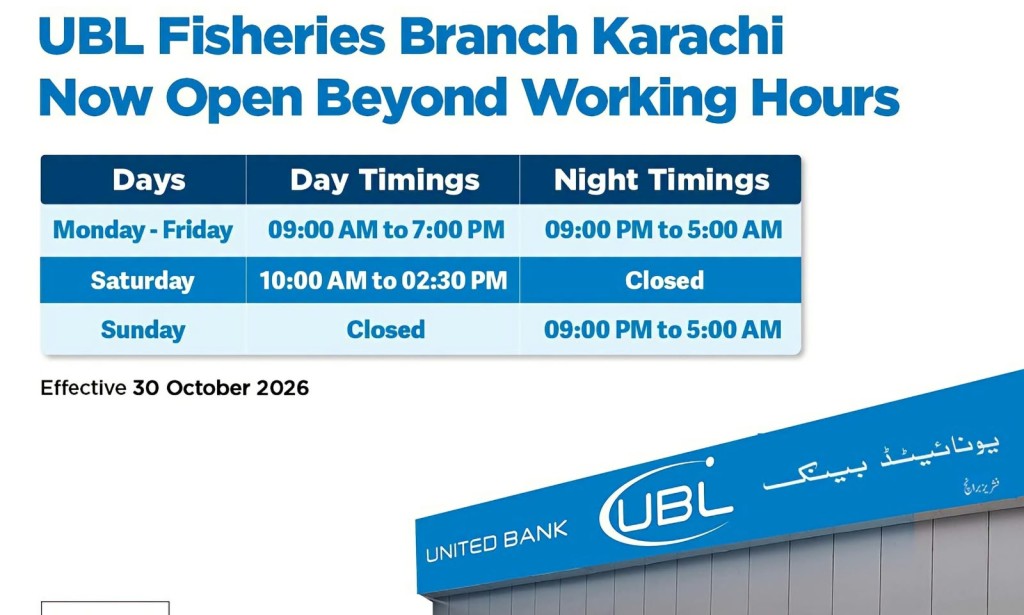
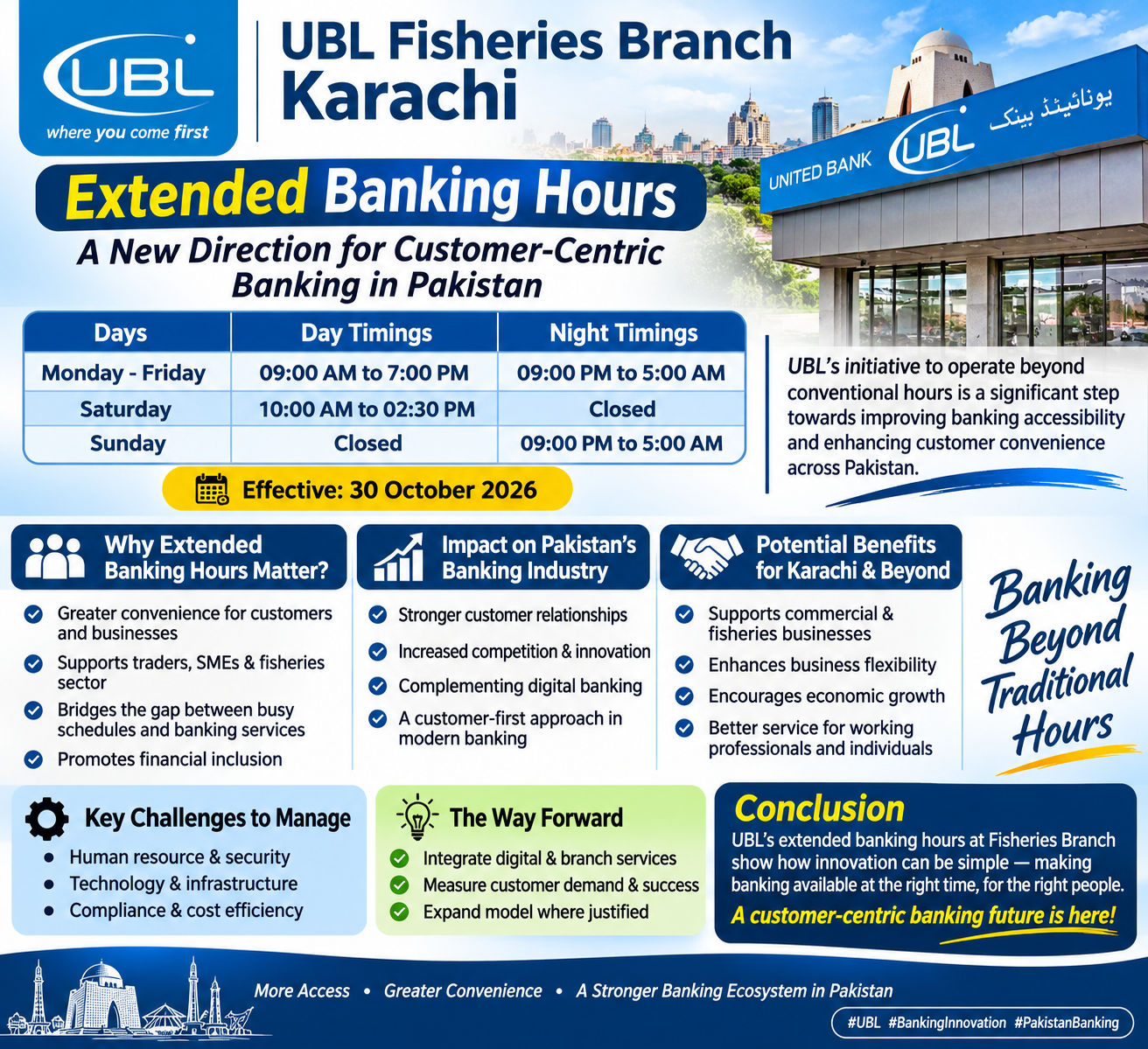
United Bank Limited (UBL) has introduced extended operating hours at its Fisheries Branch in Karachi, effective October 30, 2026, according to the shared announcement. The initiative allows customers to access branch banking services beyond conventional working hours, including overnight operations on specified days.
This development represents an interesting step towards improving banking accessibility and raises an important question: Is extended-hour branch banking becoming the next competitive advantage for Pakistan's banking industry?
1. Understanding UBL's Extended Banking Schedule
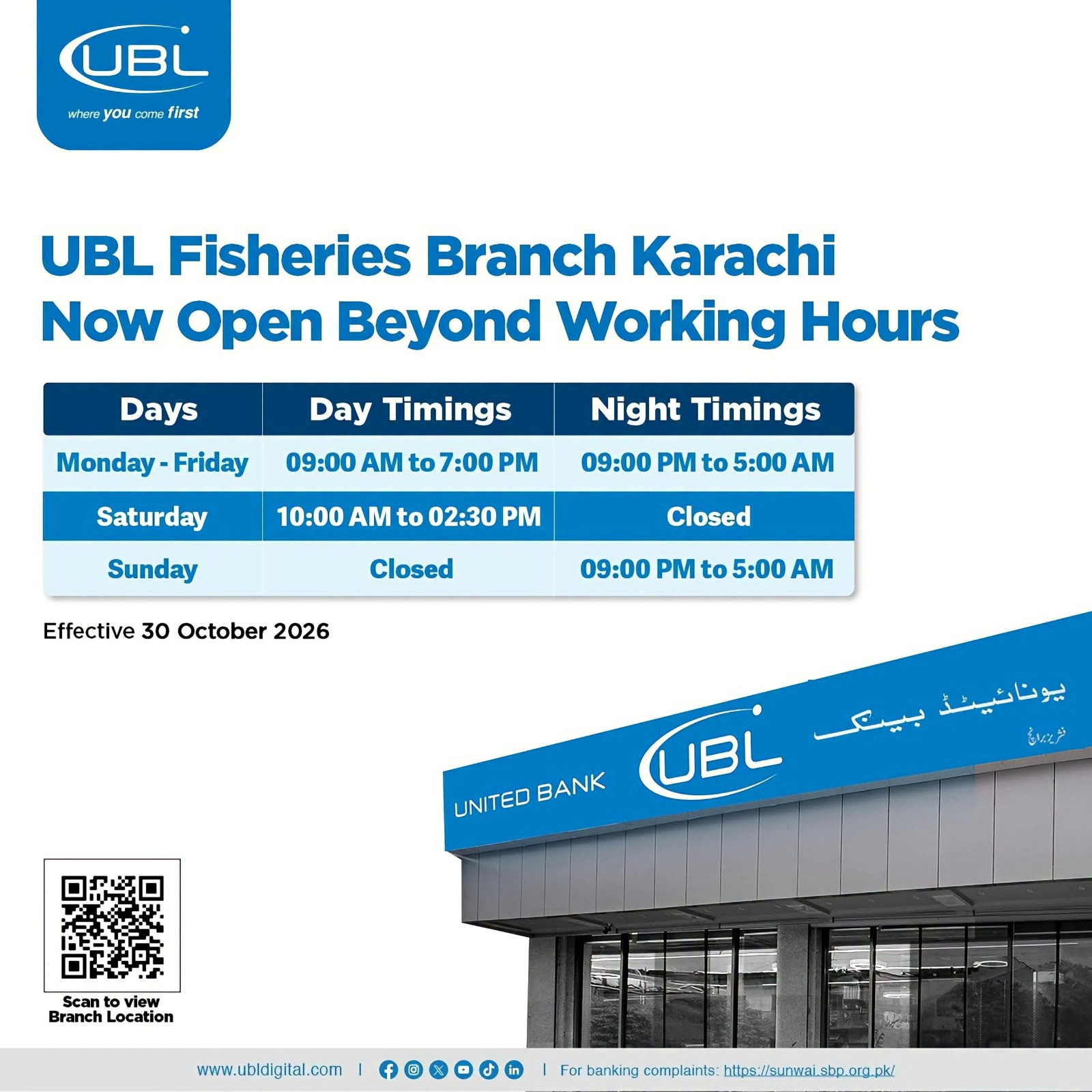
According to the announcement, UBL Fisheries Branch Karachi will operate under the following schedule:
| Days | Day Timings | Night Timings |
| Monday–Friday | 9:00 AM–7:00 PM | 9:00 PM–5:00 AM |
| Saturday | 10:00 AM–2:30 PM | Closed|
| Sunday | Closed | 9:00 PM–5:00 AM |
The schedule provides customers with additional opportunities to visit the branch outside conventional banking hours.
For businesses operating in the fisheries sector, traders, exporters, transport operators, and individuals with demanding working schedules, extended banking access could provide meaningful convenience.
However, customers should confirm which specific banking services are available during night operations.
2. Why Extended Banking Hours Matter for Pakistan's Banking Industry
Traditional banking operations generally follow fixed working schedules. Although digital banking has transformed financial transactions, physical branches remain important for services requiring personal assistance, documentation, verification, cash handling, and business relationships.
Extended banking hours can help bridge the gap between customers' working schedules and banking accessibility.
For example, a business owner who spends the entire day managing commercial activities may find it difficult to visit a branch before closing time. Extended operations provide additional flexibility.
This approach could particularly benefit:
- Small and medium-sized enterprises (SMEs).
- Traders and wholesale businesses.
- Fisheries and seafood exporters.
- Transport and logistics companies.
- Salaried individuals and professionals.
- Customers requiring branch-based financial services.
The initiative also demonstrates that physical branches can continue evolving rather than becoming less relevant in the digital banking era.
3. Potential Impact on Banking Competition
Pakistan's banking industry is highly competitive. Financial institutions continuously invest in digital channels, mobile applications, ATM networks, customer service, and operational efficiency.
However, competition should not be limited to digital innovation alone.
Extended banking hours introduce another dimension of competition:
Time-based customer service.
If customers can access banking services when they actually need them, banks may strengthen customer relationships and improve service satisfaction.
Other financial institutions may consider similar initiatives in locations where business activity continues beyond conventional office hours.
This could encourage banks to evaluate their branch operating models and identify areas where extended services would create measurable customer value.
4. Supporting Karachi's Commercial and Fisheries Sector
Karachi is Pakistan's largest commercial and financial centre, with significant activity across trading, manufacturing, transportation, logistics, and exports.
The fisheries sector is particularly important because its business operations are influenced by supply chains, transportation schedules, market demand, and export requirements.
Extended banking availability could offer several advantages:
Improved business convenience:
Traders and business owners may have additional opportunities to complete eligible banking transactions.
Better operational flexibility:
Businesses working outside traditional office hours may find it easier to coordinate certain financial activities.
Reduced scheduling pressure:
Customers may have more flexibility in managing banking visits around their commercial responsibilities.
Stronger business relationships:
More accessible branch services can support closer relationships between banks and their commercial customers.
Nevertheless, the actual benefits will depend on the services available during extended hours and the operational arrangements implemented by the bank.
5. Operational Challenges for Banks
Although extended banking hours offer potential advantages, operating a branch beyond conventional working hours also creates challenges.
Banks must carefully manage several operational areas.
A. Human Resource Management
Longer operating schedules require effective workforce planning, shift management, employee welfare, and adequate staffing.
B. Security Arrangements
Night operations require appropriate physical security, cash management procedures, surveillance, emergency arrangements, and employee transportation considerations.
C. Technology and Infrastructure
Core banking systems, communication networks, transaction monitoring, backup facilities, and operational support must remain reliable throughout extended hours.
D. Compliance and Risk Management
Banks must maintain regulatory compliance, transaction monitoring, anti-money laundering controls, customer verification, and internal audit procedures regardless of operating time.
E. Cost Efficiency
Additional operating hours can increase staffing, utilities, security, and infrastructure costs. Banks must evaluate whether additional customer activity and business opportunities justify these expenses.
Therefore, extended banking should be supported by a sustainable operating model rather than simply increasing branch working hours.
6. The Relationship Between Digital Banking and Extended Branch Operations
One important question is whether extended physical banking conflicts with the growth of digital banking.
The answer is no.
Digital banking and extended branch operations can complement each other.
Mobile banking applications, internet banking, ATMs, digital payments, and branchless banking provide customers with convenient access to routine financial services.
However, certain situations still require human interaction, physical documentation, specialized assistance, or in-person verification.
A successful banking strategy should integrate both channels.
The future of banking is not necessarily about choosing between digital and physical branches. It is about creating an interconnected financial ecosystem in which customers can access appropriate services through their preferred channels.
UBL's extended-hours initiative provides an opportunity to explore this combination.
7. Potential Benefits for Financial Inclusion
Financial inclusion is not only about opening bank accounts. It also involves ensuring that individuals and businesses can conveniently access financial services.
Customers working irregular schedules may face difficulties visiting branches during standard operating hours.
Extended banking could help address some of these accessibility barriers.
For small business owners, market traders, and workers with demanding schedules, additional service hours may create more opportunities to interact with formal banking institutions.
However, the overall impact on financial inclusion will depend on affordability, accessibility, available services, customer awareness, and the branch's ability to serve different customer groups.
8. What Other Banks Can Learn from This Initiative
UBL's Fisheries Branch announcement provides an interesting opportunity for the broader banking industry to reconsider traditional branch operating models.
Other banks could evaluate:
1. Introducing extended-hour services in major commercial markets.
2. Establishing specialized branches for export-oriented businesses.
3. Providing flexible banking schedules in industrial and trading zones.
4. Integrating branch operations with digital banking platforms.
5. Using customer transaction data to identify demand for extended services.
6. Developing measurable customer satisfaction and operational performance indicators.
Rather than introducing extended hours across every branch, financial institutions could begin with locations where customer demand and commercial activity justify the investment.
9. Measuring the Success of Extended Banking
For this initiative to become a successful banking model, performance should be evaluated through measurable indicators.
Some important indicators include:
- Number of customers visiting during extended hours.
- Transaction volumes during night operations.
- Customer satisfaction and complaint levels.
- Average customer waiting time.
- Cost per transaction.
- Operational incidents and security performance.
- Growth in commercial banking relationships.
These indicators would help management understand whether extended operations are delivering genuine customer value and financial sustainability.
10. The Future of Banking in Pakistan
Pakistan's financial sector is entering an important period of transformation. Digital payments, financial technology, mobile banking, regulatory developments, and changing customer expectations are reshaping the traditional banking environment.
In this changing landscape, banks must reconsider how, when, and where customers access financial services.
Extended banking hours could become another service differentiation strategy, particularly in commercial areas where business activities continue beyond conventional office schedules.
However, the long-term success of this model will depend on balancing customer convenience, employee welfare, security, regulatory compliance, technology, and operational costs.
The real opportunity is not simply keeping branches open longer. It is creating a banking environment that adapts to customers' lifestyles and business requirements.
Conclusion:
Banking Beyond Traditional Working Hours
UBL's extended operating schedule at its Fisheries Branch in Karachi is an interesting development for Pakistan's banking industry.
It highlights the importance of customer accessibility and demonstrates how traditional branch banking can adapt to modern commercial requirements.
For customers, extended banking hours may offer greater convenience. For businesses, they could provide additional flexibility. For the banking industry, they create an opportunity to rethink traditional service delivery models.
As financial institutions continue investing in digital transformation, initiatives like this remind us that innovation is not always about introducing new technology.
Sometimes, innovation means making existing services available at the right time, in the right place, and when customers need them most.
The future of banking will belong to institutions that do more than provide financial products. It will belong to institutions that understand their customers' time, business needs, and expectations.
#UBL #UnitedBankLimited #BankingIndustry #PakistanBanking #ExtendedBankingHours #DigitalBanking #CustomerExperience #FinancialInclusion #BankingInnovation #KarachiBusiness #SMEBanking #FinancialServices #BankingTransformation #PakistanEconomy




Comments 0
Sign in to join the conversation.
No comments yet. Be the first to say something.