

A Major Development for International Banking, Financial Institutions, AML/CFT Compliance and Global Economic Stability
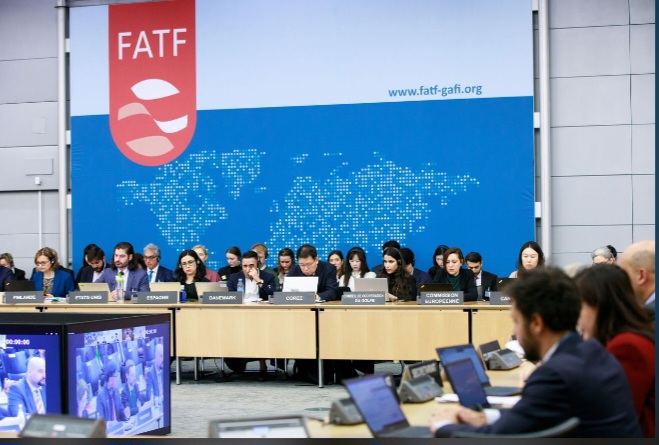
The Financial Action Task Force (FATF) has announced an important update following its October 2026 Plenary Meeting, held in Paris from 28 to 30 October. This development represents another significant step in the international effort to strengthen financial transparency, combat money laundering, prevent terrorist financing and protect the integrity of the global financial system.
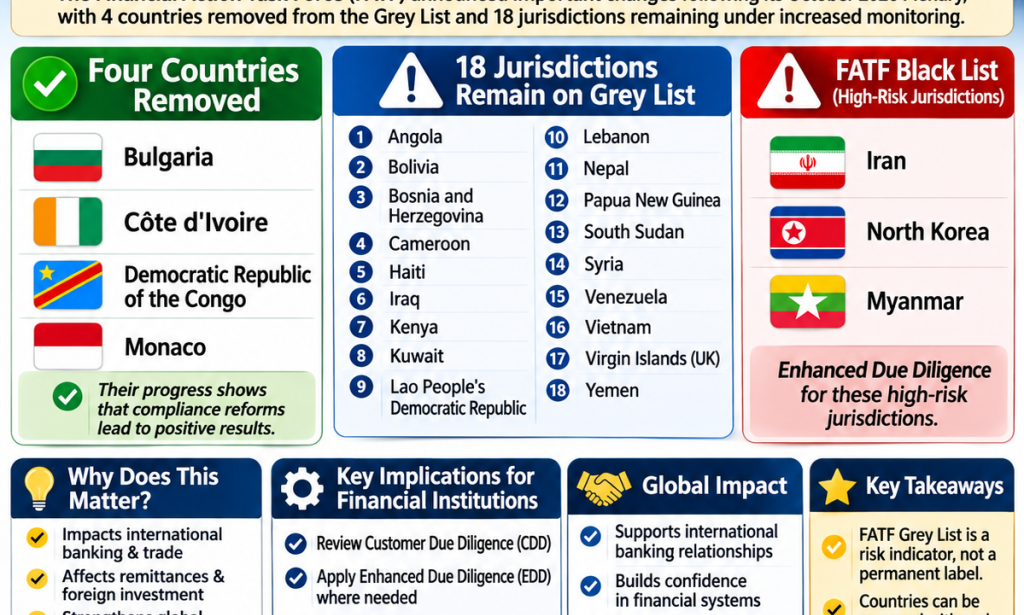
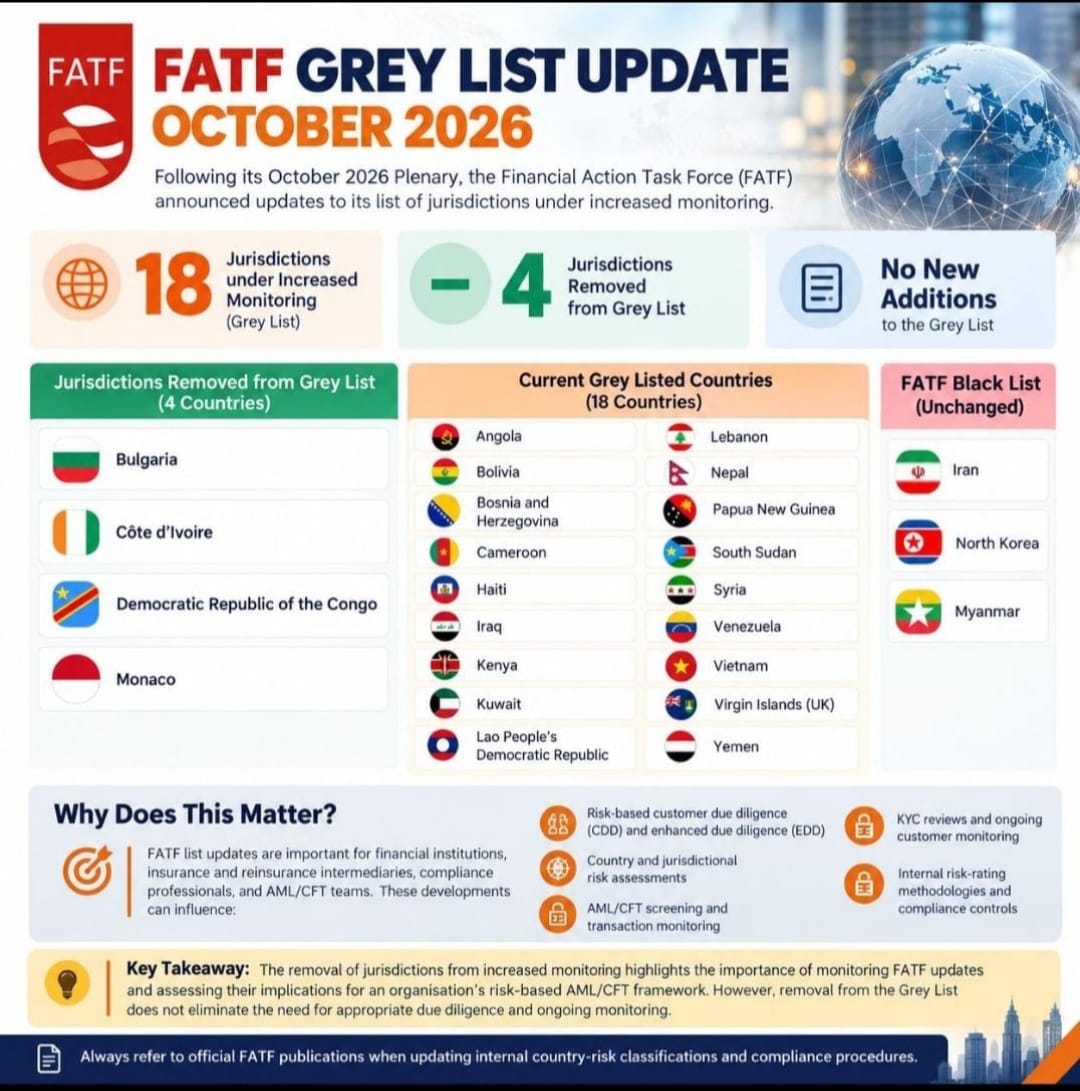
According to the latest announcement, four jurisdictions Bulgaria, Côte d'Ivoire, the Democratic Republic of the Congo and Monaco have been removed from the FATF list of jurisdictions under increased monitoring, commonly known as the Grey List.
Following these removals, 18 jurisdictions remain under increased monitoring. The FATF has also maintained its high-risk jurisdiction framework, with Iran, North Korea and Myanmar identified in its public call-for-action statements.
This announcement is more than a routine regulatory update. It carries important implications for international banking relationships, correspondent banking, cross-border transactions, foreign investment, remittance services, customer due diligence and financial institutions' risk-management frameworks.
Let's explore what this development means for the global financial industry.
1. Understanding FATF and Its Global Responsibilities
The Financial Action Task Force (FATF) is an international intergovernmental organisation established in 1989 to develop policies and standards for combating money laundering and protecting the international financial system.
Its responsibilities have expanded over time to include combating:
- Money laundering (ML).
- Terrorist financing (TF).
- Proliferation financing (PF).
- Illicit financial flows.
- Financial crime and the misuse of financial institutions.
FATF develops international recommendations and evaluates how effectively countries implement these standards.
Its work encourages governments, regulators, banks, financial institutions, insurance companies and other regulated entities to establish effective systems that identify, prevent and report suspicious financial activities.
The organisation also monitors jurisdictions that have strategic deficiencies in their anti-money laundering and counter-terrorist financing frameworks.
Two commonly discussed classifications are the Grey List and the Black List.
2. FATF Grey List: What Does It Mean?
The FATF Grey List officially refers to jurisdictions under increased monitoring.
Countries placed on this list have identified strategic weaknesses in their systems for combating money laundering, terrorist financing or proliferation financing.
However, these countries have committed to working with FATF to address the identified deficiencies within agreed timeframes.
Being placed on the Grey List does not automatically mean that a country is involved in illegal financial activities or that its entire banking system is unsafe.
Instead, it indicates that improvements are required in areas such as:
- Financial intelligence and suspicious transaction reporting.
- Investigation and prosecution of money laundering.
- Supervision of financial institutions.
- Identification of beneficial ownership.
- Implementation of targeted financial sanctions.
- International cooperation and information sharing.
- Risk-based monitoring of financial activities.
The objective is to encourage improvements in national financial systems rather than simply penalise countries.

3. October 2026: Four Countries Successfully Removed
One of the most significant developments in the October 2026 announcement is the removal of four jurisdictions from increased monitoring.
Bulgaria
Bulgaria has made significant improvements to its AML/CFT framework, including strengthening its national strategy, improving beneficial ownership information, enhancing suspicious transaction reporting and improving investigations and prosecutions of money laundering.
Côte d'Ivoire
Côte d'Ivoire has completed its agreed action plan and demonstrated progress in strengthening its financial crime prevention framework.
Democratic Republic of the Congo
The Democratic Republic of the Congo has improved its national risk assessment, financial intelligence capabilities, regulatory supervision and institutional capacity to investigate money laundering and terrorist financing.
Monaco
Monaco has strengthened its financial intelligence capabilities, improved the identification and seizure of criminal assets, enhanced regulatory enforcement and improved the effectiveness of its financial crime prevention framework.
Their removal followed successful on-site visits and recognition of progress against their respective action plans.
This is an important reminder that Grey List status is not permanent. Countries can achieve removal by demonstrating meaningful improvements and effective implementation of their commitments.
4. The 18 Jurisdictions Remaining on the FATF Grey List
As of 30 October 2026, the following 18 jurisdictions remain under increased monitoring:
1. Angola
2. Bolivia
3. Bosnia and Herzegovina
4. Cameroon
5. Haiti
6. Iraq
7. Kenya
8. Kuwait
9. Lao People's Democratic Republic
10. Lebanon
11. Nepal
12. Papua New Guinea
13. South Sudan
14. Syria
15. Venezuela
16. Vietnam
17. Virgin Islands (UK)
18. Yemen
These jurisdictions are expected to continue implementing their respective action plans and addressing the strategic deficiencies identified by FATF.
An important point for financial institutions is that the Grey List does not automatically require enhanced due diligence for every customer from these jurisdictions.
FATF specifically encourages countries and financial institutions to use a risk-based approach when assessing the risks associated with particular customers, transactions and business relationships.
This distinction is essential for maintaining financial security without unnecessarily restricting legitimate business activities, international trade or remittances.

5. FATF Black List: High-Risk Jurisdictions
The FATF also identifies high-risk jurisdictions subject to a call for action.
As of October 2026, these include:
- Iran
- North Korea (Democratic People's Republic of Korea)
- Myanmar
These jurisdictions have significant strategic deficiencies in their AML/CFT/CPF systems.
FATF calls on its members and other jurisdictions to apply enhanced due diligence in relation to high-risk jurisdictions and, in the most serious cases, appropriate countermeasures.
These requirements are different from the treatment of jurisdictions under increased monitoring.
Financial institutions must therefore distinguish carefully between Grey List and Black List classifications when developing their compliance policies.
6. Why Does This Update Matter for Financial Institutions?
The FATF announcement is particularly important for banks, microfinance institutions, exchange companies, insurance companies, remittance providers and other financial intermediaries.
Financial institutions are responsible for maintaining effective systems to identify and manage financial crime risks.
Changes in FATF country classifications can influence several areas of their operations.
A. Customer Due Diligence (CDD)
Financial institutions should periodically review their customer risk profiles and assess whether geographical exposure creates additional risks.
CDD processes should consider:
- Customer identity and verification.
- Nature of business activities.
- Source of funds.
- Source of wealth, where appropriate.
- Ownership and control structures.
- Geographic exposure.
- Transaction behaviour.
B. Enhanced Due Diligence (EDD)
EDD should be applied when the assessed customer or business relationship presents higher risks.
It may involve additional verification, more detailed source-of-funds assessments, senior management approval where required and closer monitoring.
However, institutions should avoid applying blanket restrictions simply because a jurisdiction appears on the Grey List.
C. Transaction Monitoring
Banks and financial institutions should continuously monitor transactions to identify unusual patterns, suspicious transfers and activities inconsistent with a customer's established profile.
Particular attention may be appropriate for complex cross-border transactions, unusual payment structures and transactions involving higher-risk sectors.
D. KYC and Customer Risk Reviews
Know Your Customer (KYC) information should remain accurate and updated.
Institutions should review their internal country-risk classifications whenever FATF publishes an updated statement.
E. Sanctions and Screening
Financial institutions must maintain effective screening systems covering applicable financial sanctions, designated individuals, entities and other relevant restrictions.
FATF country classifications and sanctions lists are separate compliance considerations and should not be treated as interchangeable.
7. Impact on International Banking and Correspondent Banking
Correspondent banking plays a crucial role in the international financial system.
It allows banks in different countries to facilitate international payments, trade settlements, remittances and other financial services.
However, correspondent banking relationships depend heavily on confidence in the effectiveness of financial crime controls.
When a country is placed under increased monitoring, international banks may reassess their exposure to that jurisdiction.
Potential consequences include:
- Additional compliance reviews.
- More detailed transaction assessments.
- Increased requests for supporting documentation.
- Higher operational and compliance costs.
- Longer processing times for certain transactions.
- Reassessment of correspondent banking relationships.
Conversely, successful removal from the Grey List may improve confidence in a jurisdiction's regulatory framework.
It can support efforts to strengthen international banking relationships, although removal does not automatically guarantee lower transaction costs or increased foreign investment.
The quality of a country's financial institutions, regulatory supervision and economic environment remains important.
8. Implications for Pakistan's Financial Sector
For Pakistan, FATF developments remain particularly relevant because international banking relationships, foreign remittances, trade settlements and financial transparency are important components of economic stability.
Pakistan is not among the 18 jurisdictions on the October 2026 Grey List, nor is it among the three jurisdictions subject to a call for action.
However, remaining outside these lists does not eliminate the responsibility to maintain strong AML/CFT controls.
Pakistan's banking sector must continue focusing on:
1. Strengthening customer identification and verification.
2. Improving beneficial ownership transparency.
3. Enhancing transaction monitoring capabilities.
4. Maintaining effective suspicious transaction reporting.
5. Improving risk-based supervision.
6. Strengthening compliance with applicable sanctions.
7. Enhancing cooperation between financial institutions and regulatory authorities.
8. Investing in modern financial crime detection technologies.
For Pakistani banks, exchange companies, insurance providers and remittance businesses, international compliance standards are essential for maintaining confidence among foreign financial institutions.
A strong financial compliance environment supports legitimate international transactions and helps protect the country's financial reputation.
9. The Growing Role of Technology in AML/CFT Compliance
Traditional compliance methods are increasingly insufficient to address the complexity and speed of modern financial transactions.
Financial institutions are now investing in advanced technologies to improve financial crime detection and risk management.
Some important technological developments include:
Artificial Intelligence (AI)
AI-powered systems can help identify unusual transaction patterns, detect potential fraud and improve suspicious activity monitoring.
Machine Learning
Machine learning models can analyse historical transaction information and help identify patterns that may not be easily recognised through traditional rule-based monitoring.
Automated KYC Solutions
Digital identity verification, document validation and customer screening can improve operational efficiency and reduce manual processing.
Real-Time Transaction Monitoring
Modern monitoring platforms can help financial institutions identify potentially suspicious transactions more quickly.
Regulatory Technology (RegTech)
RegTech solutions help institutions automate compliance activities, manage regulatory changes, maintain audit trails and improve reporting processes.
Technology, however, is not a replacement for sound governance, human oversight and effective compliance policies.
The most successful institutions will combine technology, skilled professionals, strong internal controls and a well-defined risk-based approach.
10. What Should Compliance Professionals Do After the October 2026 Update?
The latest announcement should encourage financial institutions to review their existing compliance frameworks.
Practical priorities include:
- Update internal FATF country-risk reference lists.
- Review customer exposure to affected jurisdictions.
- Reassess geographic risk classifications.
- Review correspondent banking relationships where relevant.
- Update AML/CFT policies and procedures.
- Reassess transaction monitoring scenarios.
- Review KYC and EDD procedures.
- Communicate relevant regulatory changes to compliance teams.
- Maintain proper documentation of risk assessments.
- Ensure that internal controls reflect the latest applicable regulatory requirements.
Institutions should also ensure that any changes to their policies are consistent with domestic laws, regulatory instructions and applicable international obligations.
Importantly, the removal of a country from the Grey List should not automatically result in the removal of all previously established customer controls.
Risk management must remain continuous.
11. The Bigger Picture: Financial Transparency and Global Economic Confidence
The October 2026 FATF update demonstrates the importance of international cooperation in protecting the global financial system.
Financial crime does not respect geographical boundaries. Money laundering networks, terrorist financing activities, fraud operations and illicit financial flows frequently involve multiple jurisdictions.
No individual country can effectively address these threats without cooperation from international regulators, law enforcement agencies, financial intelligence units and private-sector institutions.
The removal of four jurisdictions demonstrates that sustained regulatory reforms and effective implementation can produce positive results.
At the same time, the continued monitoring of 18 jurisdictions highlights that substantial work remains.
The FATF's growing attention to fraud, scam compounds and virtual assets also demonstrates how financial crime is evolving alongside digital technology.
As financial services become increasingly interconnected, institutions must strengthen their ability to identify emerging risks while ensuring that legitimate customers and businesses can continue accessing financial services.
Conclusion:
Compliance Is Not Just a Regulatory Requirement. It Is a Foundation of Financial Trust
The October 2026 FATF Grey List update is an important development for the international financial community.
The removal of Bulgaria, Côte d'Ivoire, the Democratic Republic of the Congo and Monaco reflects progress in strengthening national AML/CFT frameworks.
Meanwhile, the continued monitoring of 18 jurisdictions and the identification of three high-risk jurisdictions reinforce the need for effective financial crime prevention measures.
For banks, financial institutions, insurance companies, remittance providers and compliance professionals, the message is clear:
Financial compliance must be proactive, risk-based, technology-enabled and continuously monitored.
Regulatory compliance should not be treated as a periodic exercise undertaken only when FATF publishes a new list. It should be embedded in an institution's everyday operations, governance structure, customer relationships and risk-management culture.
Ultimately, a transparent financial system benefits everyone: governments, financial institutions, businesses, investors and ordinary customers.
Strong compliance builds trust. Trust strengthens banking relationships. And stronger financial systems support sustainable economic growth.






Comments 0
Sign in to join the conversation.
No comments yet. Be the first to say something.