

The idea that a degree is the only route to a well-paid job has not been true for over a decade, but the alternative routes are badly explained. Most online courses sell the course rather than the outcome, so people finish with a certificate and no portfolio.
The roles below are chosen because they share two properties: hiring is portfolio-driven, and the work can be learned without institutional access. Both matter, because the first means you can prove competence and the second means you can acquire it.
Why Portfolios Beat Certificates
An employer hiring for these roles has one question: can you produce acceptable work without supervision. A certificate does not answer that. Three samples in the style they need answers it in about ninety seconds.
This is also why the learning path is short. You do not need to know everything about a field. You need to be reliably good at the specific task someone will pay for, and then expand.
The Top 10 Roles
1. Front-End Developer
Building the visible part of websites and applications. HTML, CSS, JavaScript, then a framework. The most reliably in-demand technical role that does not require a degree.
Build three real interfaces, one with a live URL. A deployed portfolio beats a GitHub full of tutorials.
2. Data Analyst
Cleaning data, answering questions with it, and presenting the answer clearly. Spreadsheets, SQL, and one visualisation tool are enough to start.
Take a public dataset and publish a short written analysis. That single artefact gets interviews.
3. UX Designer
Researching how people actually use a product and designing flows that work. Less about aesthetics than most beginners expect.
Redesign one real app screen and document the reasoning. The reasoning is what gets judged.
4. Copywriter
Writing that sells: landing pages, emails, adverts, product descriptions. Purely portfolio-based and open to anyone who writes clearly.
Rewrite three existing ads and show before and after. That is your entire application.
5. Bookkeeper
Recording transactions, reconciling accounts, and preparing reports for small businesses. Steady, unglamorous, and permanently in demand.
Learn one accounting package properly. Software fluency is the barrier to entry.

6. Cybersecurity Analyst
Monitoring, incident triage, and basic defensive work for organisations. Entry-level demand is strong and the skills are learnable at home.
Set up a home lab and document one investigation you ran. Practical write-ups stand out.
7. Technical Writer
Turning complex products into documentation people can follow. Requires clear writing and the patience to read code or systems carefully.
Write documentation for an open-source project. It is public, useful, and a real reference.
8. Video Editor
Cutting long footage into something watchable. Almost every business now needs this and most cannot do it themselves.
Edit a two-minute highlight from a longer clip and publish both for comparison.
9. SEO Specialist
Understanding what people search for and structuring content to answer it. Half research, half writing, and measurable in months rather than years.
Take one small site and improve one page, then show the traffic change.
10. Salesforce or ERP Administrator
Configuring the business software companies already pay for. Certifications are cheap, demand is constant, and the work is process rather than creativity.
Free training environments are available. Build one working configuration as a sample.
How to Learn Without Wasting a Year
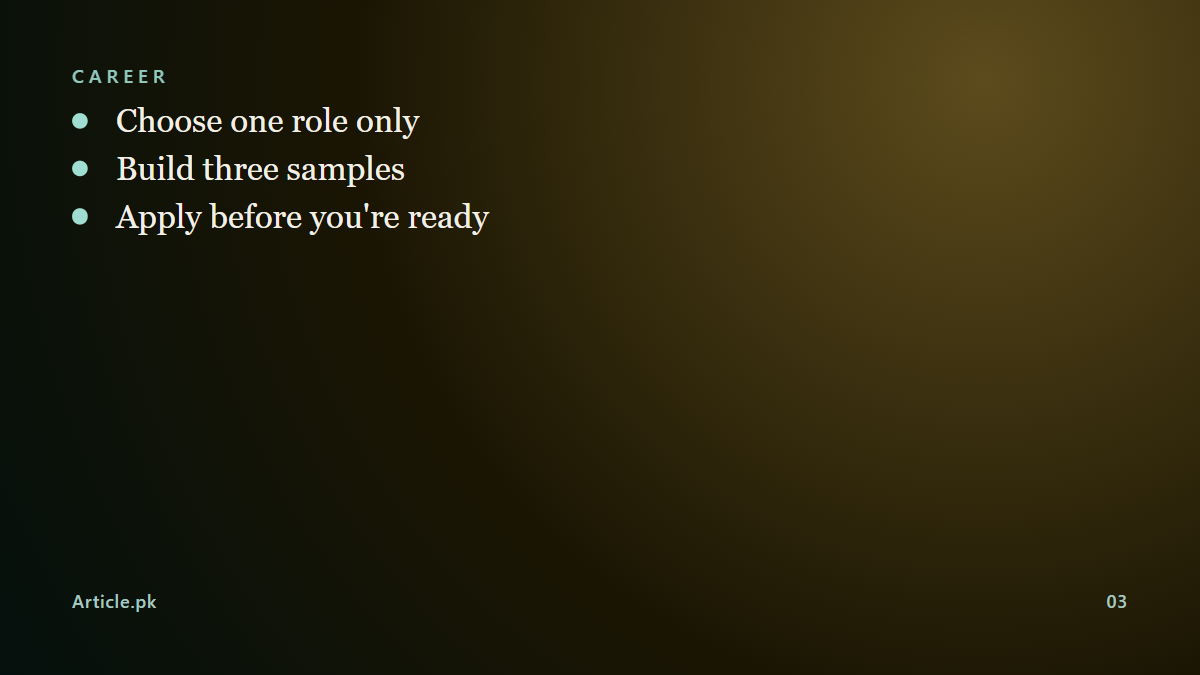
Pick one role. Find three job adverts for it and copy the exact requirements into a list. Learn only those items, in order. That list is a curriculum written by the market rather than by a course seller.
Build one sample after each third of the list. Apply for work before you feel ready, because the feedback from a real brief teaches faster than any exercise.
The Money Question, Honestly
Entry-level pay in these roles is not dramatic. The first job pays modestly, the third pays properly, and the ceiling is set by how specialised you become rather than how long you have worked.
Freelance rates start low and climb with proof. Two years of delivered work in a narrow specialism beats five years of general experience on a rate card.
The trap is spreading thin. A designer who also writes, edits, and does SEO competes on price with everyone. A designer who only does onboarding flows for subscription apps can charge several times more for the same hours.
Also budget for the unpaid period. Most people need three to six months of learning before the first paid work, and having money set aside for that window is the difference between finishing and abandoning halfway.
How to Get the First Client Without Experience
Nobody hires a stranger with no track record, so the first job has to be created rather than won. The reliable method is to find a business with an obvious, specific problem and solve a small piece of it for free, publicly, before asking for anything.
Rewrite a poorly performing landing page and send it to them with a short note explaining the change. Design one screen of their app and share it. Edit ninety seconds of their worst video. The work is the introduction.
Send ten of these rather than one, and expect most to produce nothing. The ones that respond are your first clients, and they will pay because you have already demonstrated the outcome rather than described it.
Charge for the second job, always, even if the first was free. Working for free twice sets a pattern that is difficult to reverse and attracts the wrong kind of client.
Then ask every person you did work for one question: who else do you know with this problem. Referrals from a happy client convert far better than anything you can cold-send.
The Habit That Decides Whether This Works
Almost everyone who succeeds at this does the same unremarkable thing: they keep a public record of what they build. A simple page listing each sample with a date and a link. It takes minutes to maintain and it does more for credibility than any certificate, because it shows continuity rather than a one-off burst of enthusiasm.
Six months of that record is a career change. Six months without it is six months of courses.
The Bottom Line
Choose one role, learn exactly what the adverts ask for, and build three public samples. The portfolio is the qualification, and everything else is preparation for making it.





Comments 0
Sign in to join the conversation.
No comments yet. Be the first to say something.