

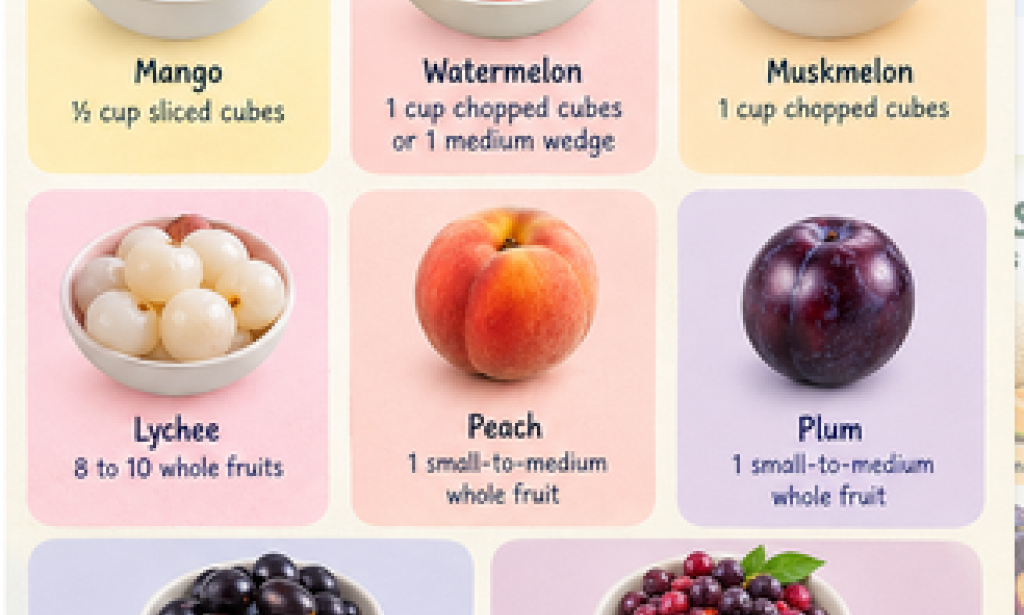
As temperature rises, fruit is the best thing to eat for vitamins, minerals and dietary fiber. Most people wonder whether there is a specific time to eat fruits for better health benefits or not?
Well, currently there is no strong scientific evidence about the exact timings. This article will be informative enough to help you explore nutritional values, health benefits and suggest you proportion and appropriate ways so that you can enjoy the fruits available in Pakistan.
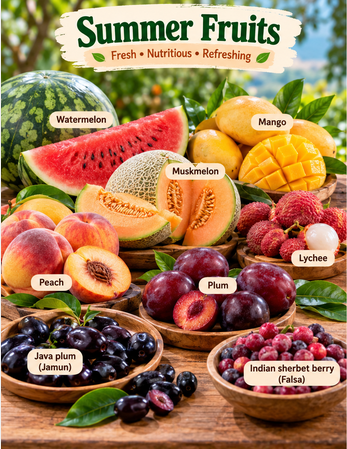
NUTRIENT VALUES AND SUGGESTED EATING TIME
Nutrient values per 100 g of raw edible fruit: Nutrients values are reported per 100g of edible portion of the food in food-composition database. The values vary according to the variety of fruit and data source. The table below presents nutrient values with USDA FoodData Central used as a reference.
FRUITS | MAIN NUTRIENTS PER 100 g | TIMINGS |
Mango | 60 calories,15g carbohydrates, 13.7g sugar,1.6g fiber, 0.82g protein, 0.38g fat, 36.4mg Vitamin C, 54mcg RAE Vitamin A. | Enjoy with a snack or meal. |
Watermelon | 30 calories, 91.4g water, 7.6g carbs, 6.2g sugar, 0.4g fiber, 0.6g protein, and 0.2g fat | Enjoy between meals or with meal. |
Muskmelon | 90.2g water, 34 calories, 8.2g carbohydrates, 7.9g sugar, 0.9g fiber, 0.8g protein, 0.2g fat, 36.7mg Vitamin C, 169mcg Vitamin A. | Enjoy with a meal or as refreshing snack |
Lychee | Calories 66 kcal, Water 81.8 g, Carbohydrates 16.5 g, Sugar 15.2 g, Dietary fibre 1.3 g, Protein 0.8 g, Fat 0.4 g, Vitamin C 71.5 mg, Potassium 171 mg
| Enjoy as snack but in moderate quantity |
Peach | 88.9g water, 39 calories, 9.5g carbohydrates, 8.4g sugar, 1.5g fiber, 0.91g protein, 0.25g fat, 6.6mg Vitamin C,16mcg Vitamin A | Enjoy before physical activity or as a snack |
Plum | 87.2g water, 46 calories, 11.4g carbohydrates, 9.9g sugar, 1.4g fiber, 0.7g protein, 0.28g fat, 9.5mg Vitamin C, 157mg potassium | Enjoy as snack, fiber in it helps in bowel movement |
Java plum (jamun) | 60 kcal, 83.13 g water, 15.56 g carbohydrates and 14 g, Dietary fibre 3.4 g, Protein 0.6 g, Fat 0.3 g
| Enjoy as seasonal snack |
Indian sherbet berry (Falsa) | Carbohydrates 21.1 g, Dietary fibre 5.53 g, Protein 1.57 g, Fat Less than 0.1 g, Potassium 372 mg, calcium 136 mg, iron 1.08 mg and phosphorus 24.2 mg
| Enjoy as seasonal snack |
FRUIT CONSUMPTION: MYTHS AND FACTS
MANGO
Eating a large amount after a heavy meal may cause fullness or discomfort in some people, but this is not specific to mango, causing gas, bloating and acid reflux. Mango contains natural sugars and can raise blood glucose. However, eating it at night does not automatically cause a larger blood sugar spike. Portion size and individual glucose regulation matter.
WATERMELON
Watermelon contains approximately 91% water. Eating a large portion close to bedtime may increase nighttime urination in some people, but it does not necessarily disturb sleep.
Watermelon does not generally slow digestion or overstretch the stomach simply because it is eaten after a meal. A large portion may contribute to temporary fullness.
MUSKMELON
A large portion may cause fullness or bloating in some people, but this depends individual
tolerance and meal size
LYCHE
Lychee contains natural sugars and can raise blood glucose, but the body does not become unable to process sugar at bedtime. The effect depends on portion size and individual health.
PEACH
Peach provides water and potassium and can be a refreshing snack before exercise. However, its potassium content alone cannot guarantee prevention of muscle cramps.
PLUM
Eating a large amount of plum may cause gas, bloating or loose stools in people sensitive to sorbitol. These effects are related to the amount eaten and individual tolerance, not specifically to nighttime consumption.
JAVA PLUM (Jamun)
Jamun contains natural plant acids, but there is insufficient evidence that eating it on an empty stomach generally causes excess stomach acid, nausea or vomiting. People who experience discomfort can try a smaller portion or eat it with other food.
INDIAN SHERBET BERRY (Falsa)
Falsa has a naturally tart taste because it contains organic acids. However, there is no good evidence that it burns the stomach lining in healthy people. Those with acid reflux or a sensitive stomach may limit it if it triggers symptoms.
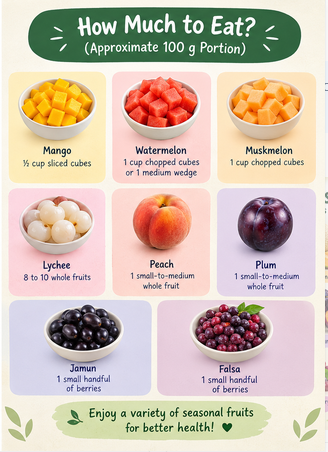
QUANTITY TO TAKE FOR BETTER ABSORPTION
Without using digital scale eat fruit with standard 100g proportion
1. Eat mango about half a cup of sliced cubes.
2. Eat watermelon aboutone cup of chopped cubes or one medium wedge.
3. Eat lycheeabout 8 to 10 whole fruits.
4. Eat peach and plum about one small-to-medium whole fruit.
Eat jamun and falsa aboutone small single handful of berries.
HEALTH BENEFIT OF EACH FRUIT
1. MANGO
It lowers the fasting blood glucose, improves the insulin sensitivity and stabilizes long-term
HbA1c.
According to research: Its primary active plant polyphenol (mangiferin) which clinical
trial shows fights cellular inflammation and prevents sudden glucose spikes after meals.
2. WATERMELON
It lowers the blood pressure, relaxes blood vessels and improve cardiac functions.
According to research: It is a powerhouse for (L-citrulline) an amino acid that your body converts to widen blood vessels. It is also packed (lycopene) an antioxidant that stops bad cholesterol from building up in the arteries.
3. MUSKMELON
It helps in soothing and protecting stomach from ulcer and provides deep hydration.
According to research:It contains triterpenoids and sterols that helps stomach to produce protective mucus, reducing irritation and bloating and its 90.2% water content hydrates cells.
4. LYCHE
It is loaded with vitamin C, improves immune system and lowers inflammation.
According to research: Lychee is packed with proanthocyanidins, clinical trials show that it
can help stop abnormal cell growth and strengthen blood vessel walls against chronic
swelling.
5. PEACH
It helps muscle recover quickly and keeps skin healthy.
According to research: The natural mix of potassium and water stops painful muscle cramps and its vitamins protect your skin from sun damage.
6. PLUM
It protects stomach lining and prevents constipation.
According to research: Plums contains natural plant sugar alcohol called sorbitoland soluble fibers that pull water into the digestive tract, moving food through the system without chemical laxatives
7. JAVA PLUM (JAMUN)
It has ability to lower the blood sugar levels, it is very helpful in managing diabetes naturally.
According to research:
Jamun seeds and pulp contain jamboline and jambosine, that slow down your body's speed of turning food starches into sugars, preventing heavy post-meal spikes.
8. INDIAN SHERBET BERRY (FALSA)
It treats high fever as it instantly cools body and prevents heatstroke.
According to research: It is loaded with anthocyanins and a high level of sodium and potassium, which rapidly repairs electrolyte imbalances in intense summer heat.
CONCLUSION
Apart from being delicious, summer fruits are rich in vitamins, minerals, fiber and water that supports our health. Each fruit has different nutritional benefits. There is no single timing best for eating specific fruit, quantity and health needs are more important; so enjoy the seasonal fruits by making them part of your balanced diet.
SOURCES
2. Harvard Healthy Eating Plate








Comments 0
Sign in to join the conversation.
No comments yet. Be the first to say something.