

Why Deepfakes Matter to Everyone
For many years, a video or a voice note was treated as strong proof. If you saw someone say something on camera or heard their voice on a call, you believed it. Artificial intelligence (AI) has changed that. Today, AI tools can clone a voice from a short audio clip and create realistic fake videos, photos and recordings. These fakes are called deepfakes.
You do not need to be famous to be affected. Anyone who has a public video, a voice note or a social media profile can be copied, and so can the people who trust them: family members, customers, employees and colleagues. There is a second problem too. When fakes become common, people start doubting real evidence as well. A genuine video can be dismissed as "AI-made," and a fake one can be believed.
This is why knowing how to verify content is quickly becoming a basic digital skill, as important as never sharing your OTP code with anyone.
How Deepfakes Are Misused
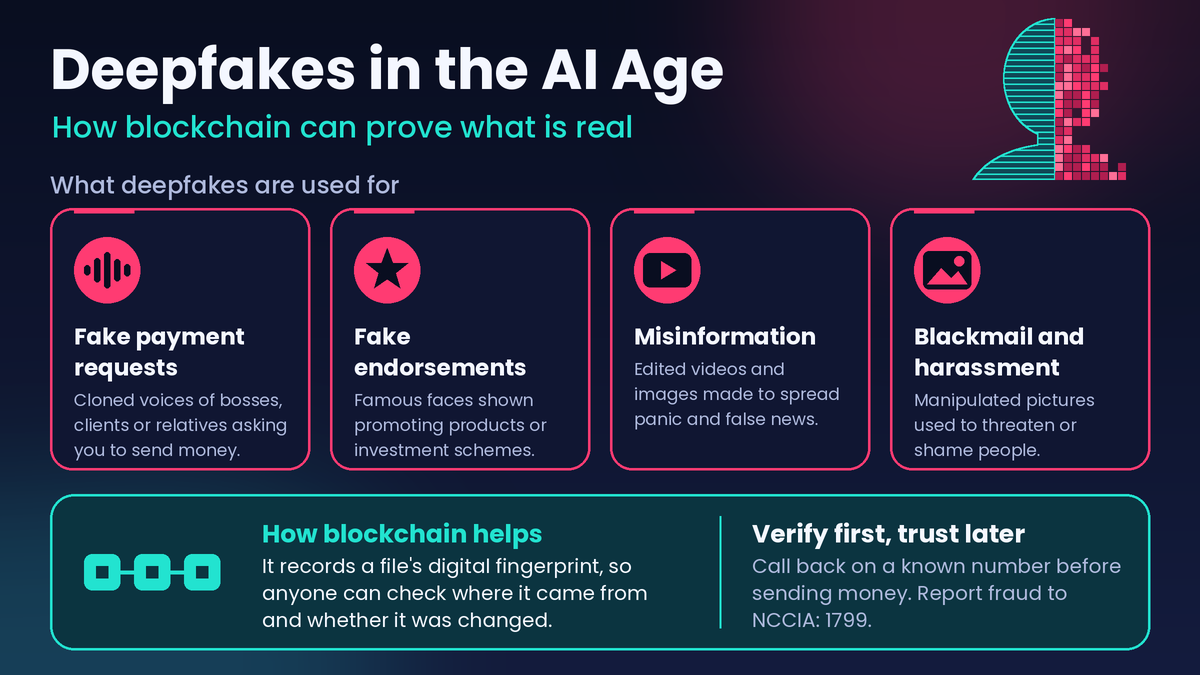
Deepfakes are not only a technical curiosity. They are already used in ways that can harm people:
Fake payment requests: a cloned voice of a boss, client or relative asks for an urgent money transfer.
Fake endorsements: well-known faces appear to promote a product, giveaway or investment scheme they have never heard of.
Misinformation: edited videos and images are shared to spread panic or false news.
Blackmail and harassment: manipulated pictures are used to threaten, shame or pressure people.
What these misuses have in common is trust. Scammers rely on the fact that we trust familiar voices and faces. They also rely on urgency, so that we act before we think.
Why Looking and Listening Is No Longer Enough
Earlier, spotting a fake meant looking for obvious mistakes, such as strange lip movement or a robotic voice. As the tools improve, these signs are becoming harder to notice, especially on a small phone screen, in a noisy place, or in a short voice note. Relying only on your eyes and ears is not a safe strategy anymore. We need ways to check where content came from, not just how it looks.
Where Blockchain Fits In
Blockchain is best known for cryptocurrency, but its core feature is much broader: it stores records in a way that is extremely difficult to change secretly.
It is important to be clear about one thing. Blockchain cannot look at a video and tell you if it is fake. What it can do is prove where a file came from and whether it has been changed since it was registered.
Here is how the process works in simple steps:
A file is created, such as a photo, video or audio recording.
A digital fingerprint (called a hash) is generated from the file. If even a tiny detail is edited, the fingerprint changes completely.
The fingerprint is recorded on a blockchain along with a date and time. Once saved, it cannot be quietly altered.
Anyone can verify the file later by comparing its fingerprint with the record. A match shows the file is unchanged. A mismatch shows it has been modified.
You can think of it like an official stamp on a sealed envelope. The stamp does not tell you what is inside, but it shows whether someone has opened and tampered with it.
Blockchain Is Not Working Alone
No single technology can solve this problem. Several approaches are being developed together:
Content credentials: An industry standard called C2PA, supported by major technology companies including Adobe and Microsoft, attaches information to media showing who created it and whether it was edited or generated with AI.
AI detection tools: Software that looks for signs of manipulation in images, audio and video.
Blockchain records: A tamper-resistant way to store proof of origin so it cannot be changed later.
Each of these covers weaknesses in the others. Detection tools can make mistakes, while blockchain records are permanent but only work for content that was registered in the first place.
Limitations to Keep in Mind
Blockchain is helpful, but it is not a magic shield. It is better to understand its limits:
It only proves the status of content that was registered. Unregistered fake content is not automatically flagged.
Many apps, cameras and social media platforms do not support this kind of verification yet.
A record can prove a file is unchanged, but it cannot prove that what the file shows is true.
Being honest about these limits matters, because false confidence is also a risk. A "verified" label is useful, but it should be one check among several, not the only one.
How to Protect Yourself
Technology is still developing, so good habits are your best defence today:
Do not send money based only on a voice note, call or video. Confirm the request by calling back on a number you already know.
Agree on a code word with family members or business partners for urgent requests.
Be careful with urgent messages. Scammers create pressure so that you don't stop to think.
Check the source of shocking news, videos or celebrity offers before sharing them. If only one unknown page is posting it, wait.
Limit clear public recordings of your voice and face if you don't need them online, and keep your social media privacy settings tight.
Never share OTP codes, PINs or wallet details, even if the caller sounds familiar.
Talk to your family, especially parents and elders who may trust voice messages more easily.
If You Become a Victim
Do not panic and do not stay silent. Report the incident to the National Cyber Crime Investigation Agency (NCCIA) by calling its helpline, 1799. Cybercrime complaints received through Police Emergency Helpline 15 are also forwarded to the relevant NCCIA zone. Keep screenshots, messages, account numbers and call records as evidence, and report as early as possible.
If money was sent through a bank or mobile wallet, contact that service right away as well.
What This Means for the Future
AI will keep getting better, and so will fakes. But the tools for proving authenticity are growing too. Blockchain-based proof of origin, content credentials and AI detection are slowly giving news organisations, businesses and ordinary users a way to check what is real. Until these tools become common, awareness is the first and cheapest layer of protection.
Conclusion
AI has made convincing fakes easy to create, and this will not change soon. But technology can also help rebuild trust. The safest rule is simple: verify first, trust later. A phone call or a few extra minutes of checking can save you from a costly mistake.



Comments 0
Sign in to join the conversation.
No comments yet. Be the first to say something.