
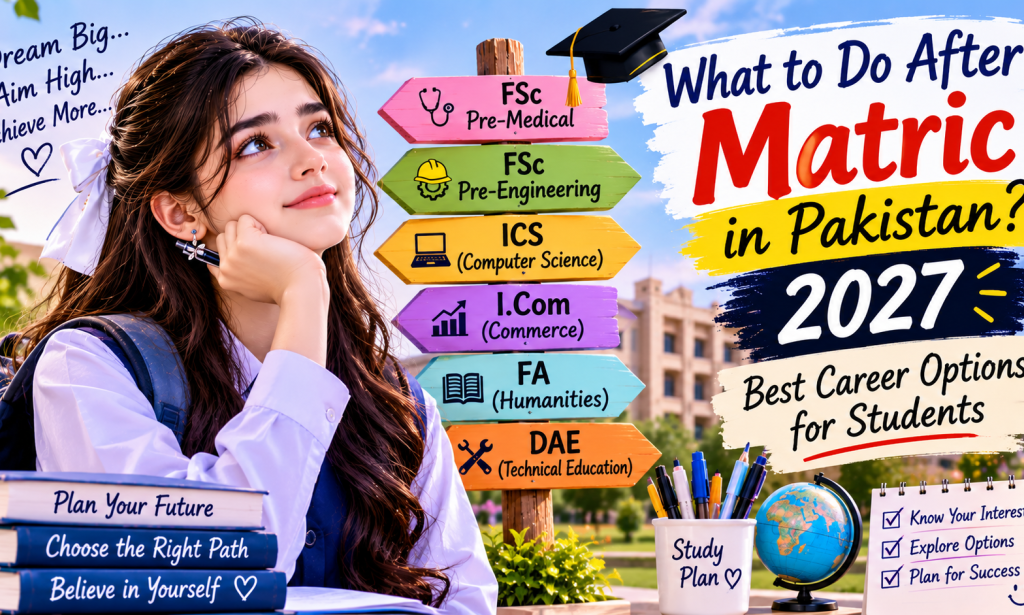
Completing Matriculation is an important milestone in every student's life. It is the stage when students begin thinking seriously about their future education and career. Some dream of becoming doctors, engineers, teachers, or computer scientists, while others want to explore business, technology, or creative fields.
However, choosing the right career after Matric can be confusing. Students often face pressure from family members, friends, and society. Many choose a field simply because their friends have selected it or because people consider it more prestigious.
But is that the right way to plan a future?
The answer is no. Every student has different abilities, interests, and dreams. The best career choice is one that matches a student's interests, academic strengths, and future goals.
Let's explore some of the best educational and career options available to students in Pakistan after Matric in 2027.
1. FSc Pre-Medical: For Students Who Dream of Working in Healthcare
Students who enjoy Biology, Chemistry, and understanding the human body can consider FSc Pre-Medical.
This programme is a common pathway for students interested in medical and healthcare professions.
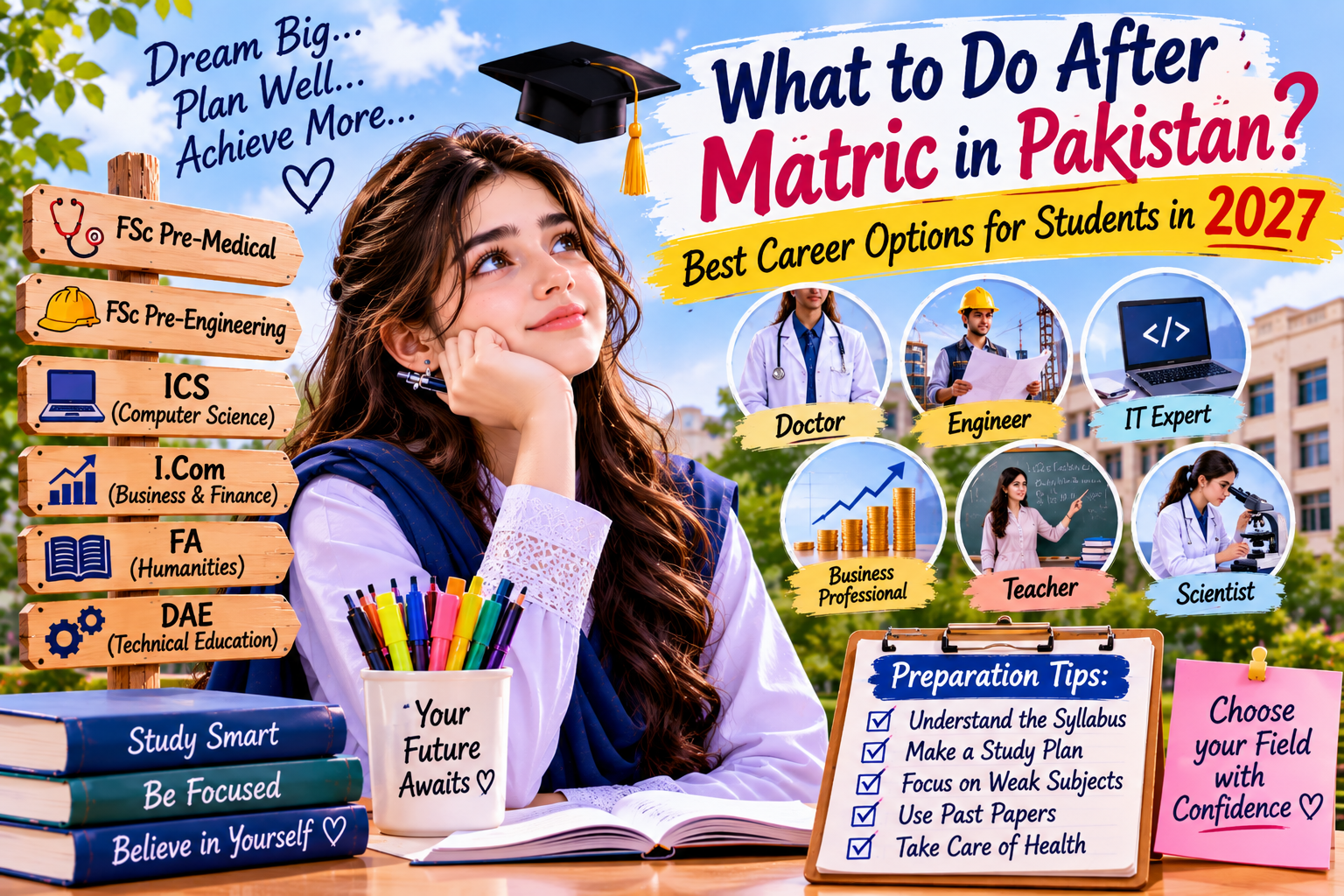
After completing FSc Pre-Medical, students may explore careers such as:
MBBS (Doctor)
BDS (Dentist)
Doctor of Physical Therapy (DPT)
Pharmacy
Nursing
Medical Laboratory Technology
Biotechnology
Nutrition and Dietetics
Students interested in MBBS and BDS must also meet the relevant admission requirements and qualify through the required entrance examination, including MDCAT where applicable.
However, becoming a doctor is not the only successful career in healthcare. Many other medical and allied health professions offer opportunities to serve people and build a meaningful future.
2. FSc Pre-Engineering: Build a Future Through Science and Technology
Students who enjoy Mathematics, Physics, and problem-solving may consider FSc Pre-Engineering.
This field develops analytical thinking and provides a foundation for several technical and scientific disciplines.
Possible future career options include:
Civil Engineering
Electrical Engineering
Mechanical Engineering
Chemical Engineering
Computer-related degrees, subject to university eligibility
Mathematics and Physics
Engineering Technology
Students interested in designing buildings, developing machines, or working with modern technology may find this field suitable.
Before selecting Pre-Engineering, students should honestly evaluate their interest in Mathematics because regular practice and strong conceptual understanding are essential.
3. ICS: An Opportunity in the Digital World
Technology is becoming an important part of everyday life. From mobile applications to artificial intelligence, computers are changing the way people study, work, and communicate.
ICS (Intermediate in Computer Science) is a suitable option for students interested in computing and digital technology.
After completing ICS, students may explore:
BS Computer Science
Software Engineering
Information Technology
Artificial Intelligence
Data Science
Cybersecurity
Web Development
Students can also develop practical skills in programming, graphic design, website development, and digital applications alongside their studies.
However, admission requirements and accepted subject combinations vary between universities. Students should check the eligibility criteria before choosing their intermediate subjects.
4. I.Com: A Pathway to Business and Finance
Not every student wants to become a doctor or engineer. Some students are interested in business, banking, accounting, and financial management.
For these students, I.Com can be a useful educational choice.
This programme introduces students to important business and commerce concepts.
After completing I.Com, students may consider:
BBA
BS Accounting and Finance
Commerce
Banking and Finance
Business Management
Professional accounting qualifications such as ACCA or CA, subject to admission requirements
Students who enjoy working with numbers, understanding financial systems, and managing business activities may find this field interesting.
Business education can also help students who dream of starting their own companies in the future.
5. FA: Explore Humanities, Education, and Creative Careers
FA is another valuable option for students who are interested in languages, social sciences, communication, and humanities.
Unfortunately, some people consider arts and humanities less valuable than science. This is an incorrect way of thinking.
Every educational field has its own importance.
After FA, students may explore different degree programmes and careers, including:
Psychology
English Literature
Journalism
Education
Law, subject to admission requirements
International Relations
Political Science
Sociology
Media and Communication
Students who enjoy reading, writing, teaching, understanding society, and communicating with others may find humanities particularly rewarding.
A successful career depends on knowledge, skills, dedication, and the right opportunities, not simply the name of an educational group.
6. DAE and Technical Education: Learn Practical Skills
Some students prefer practical work instead of following a traditional academic route.
For such students, technical education can be an excellent option.
DAE (Diploma of Associate Engineer) is generally a three-year technical programme available in different specialisations.
Common areas include:
Electrical Technology
Civil Technology
Mechanical Technology
Electronics
Computer Technology
Automotive Technology
Technical education allows students to develop practical knowledge and professional skills.
Depending on their qualification and eligibility, students may pursue employment opportunities or continue towards further technical education.
Students should explore recognised institutions and confirm programme accreditation before applying.
7. Learn Digital Skills Alongside Your Education
In 2027, having academic qualifications is important, but practical skills can provide additional opportunities.
Students can gradually learn useful digital skills alongside their regular studies.
Some examples include:
Graphic Designing
Content Writing
Video Editing
Web Development
Digital Marketing
Programming
Communication Skills
English Language Skills
These skills can help students understand modern workplaces and explore different professional interests.
However, students should not leave their regular education simply because they have discovered online earning opportunities.
Education and practical skills can work together.
8. Five Important Questions Before Choosing a Career
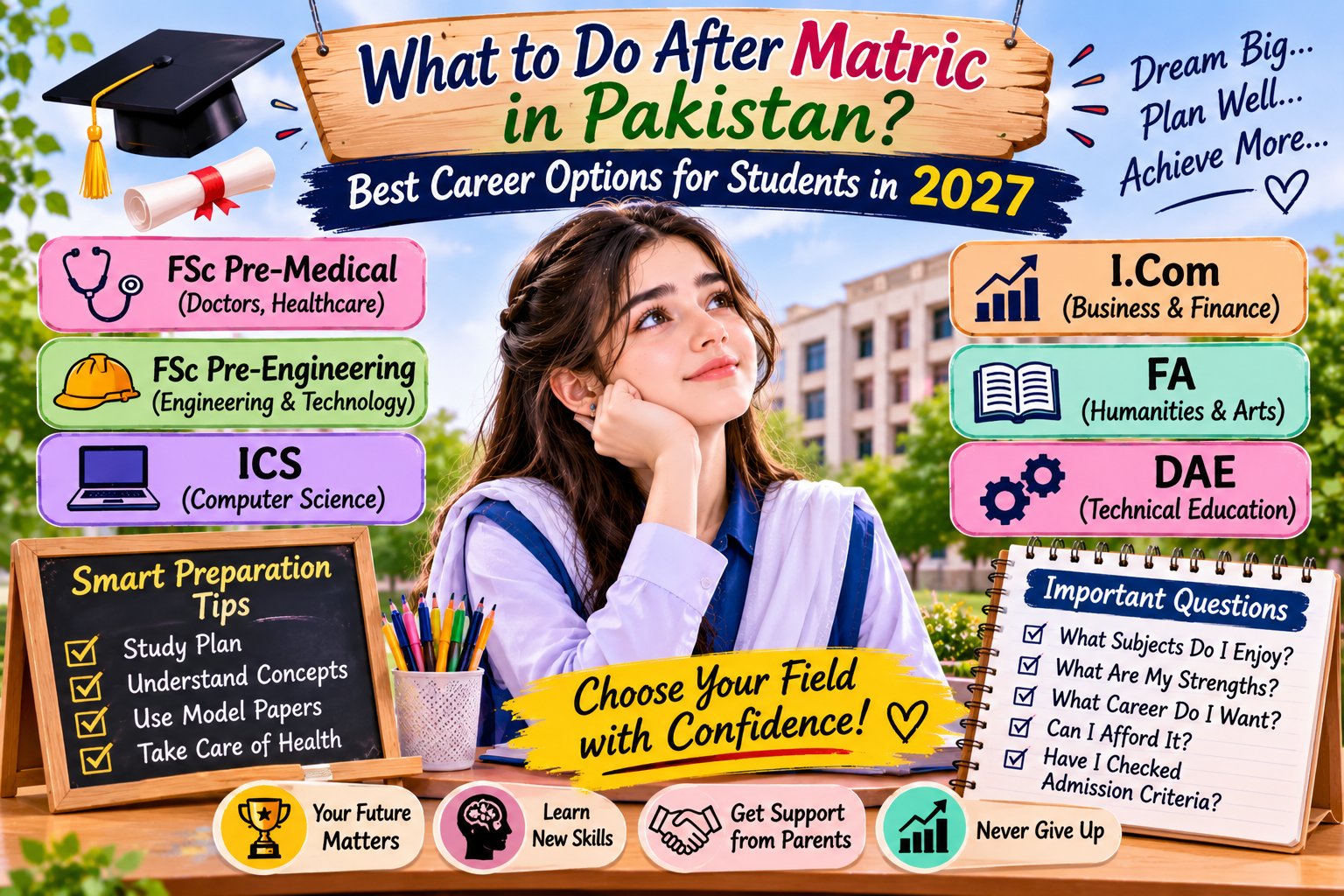
Before selecting a field after Matric, every student should ask themselves five questions:
1. What subjects do I enjoy?
Choose subjects that genuinely interest you. Studying becomes more productive when you are curious about what you learn.
2. What are my strengths?
Some students are good at Mathematics, while others have strong communication, writing, creative, or scientific abilities.
Understand your strengths before making a decision.
3. What career do I want in the future?
Think about the type of work you would enjoy doing. Research the educational requirements of that profession.
4. Can I afford the educational programme?
Consider tuition fees, books, transportation, and other expenses. Explore scholarships and affordable institutions if needed.
5. Have I checked admission requirements?
Different colleges and universities have different eligibility criteria. Always check official admission information before selecting a subject combination.
9. The Role of Parents in Career Selection
Parents have an important role in shaping their children's educational journeys.
However, forcing children to choose a particular profession can create unnecessary pressure.
A child should not be expected to become a doctor simply because a family member is a doctor.
Parents should listen to their children's interests, discuss available opportunities, and help them make informed decisions.
Teachers can also guide students through career counselling sessions, aptitude discussions, and educational awareness activities.
Sometimes, one supportive conversation can help a confused student discover a direction for the future.
10. Your Matric Result Does Not Define Your Entire Future
One of the most important messages every student needs to understand is that examination marks do not determine a person's entire worth or future potential.
Good marks can create opportunities, but success also requires patience, discipline, practical knowledge, and continuous learning.
Students who achieve average marks can also build successful careers by choosing suitable educational pathways and working consistently towards their goals.
If you do not achieve the result you expected, do not lose hope. Discuss your options with teachers and career counsellors, understand the available pathways, and make a realistic plan.
There is always an opportunity to learn, improve, and move forward.
Conclusion
Choosing a career after Matric is an important decision, but it should not become a source of fear or unnecessary pressure.
Pakistan offers different educational pathways, including FSc Pre-Medical, FSc Pre-Engineering, ICS, I.Com, FA, and technical education.
Every field has its own value and opportunities. The right choice depends on a student's interests, abilities, financial circumstances, and future ambitions.
Students should research their options, consult experienced teachers, check official admission requirements, and make decisions carefully.
Remember, your future is not determined by what other people expect from you. It is shaped by the knowledge you gain, the decisions you make, and the effort you put into achieving your dreams.
Choose your field with confidence, work hard with consistency, and never stop believing in your abilities. Your future begins with the choices you make today.







Comments 0
Sign in to join the conversation.
No comments yet. Be the first to say something.