


College does not usually become difficult because the subjects suddenly become impossible. For many students, the real difficulty begins when no one is standing behind them, reminding them what to study, when to study, and what needs to be completed first.
School often provides a visible structure: fixed periods, regular homework, frequent reminders and teachers who notice when something has not been completed. College offers considerably more freedom. That freedom can be useful, but it can also make academic responsibilities surprisingly easy to postpone.
A student may attend classes all day, return home exhausted, open a book for an hour and still feel as though nothing meaningful was accomplished.
The problem is not always laziness.
Sometimes, it is the absence of a workable system.
A productive study routine is not a timetable filled with unrealistic eight-hour study sessions. It is a structure that helps a student decide what deserves attention, when the mind is most capable of learning, and how to continue when motivation disappears.
Why Most Study Timetables Fail
The internet is full of beautifully designed study schedules. Many of them divide the day into perfect blocks: mathematics at 7:00, chemistry at 8:00, revision at 9:00, reading at 10:00, and so on.
The timetable looks impressive.
Then real life happens.
A lecture takes longer than expected. A student comes home tired. A family responsibility appears. A chapter turns out to be more difficult than anticipated. One missed session becomes two, and eventually the entire timetable is abandoned.
This happens because many study plans are designed around an ideal student rather than a real person.
A sustainable routine must account for tiredness, interruptions, difficult subjects and unexpected changes.
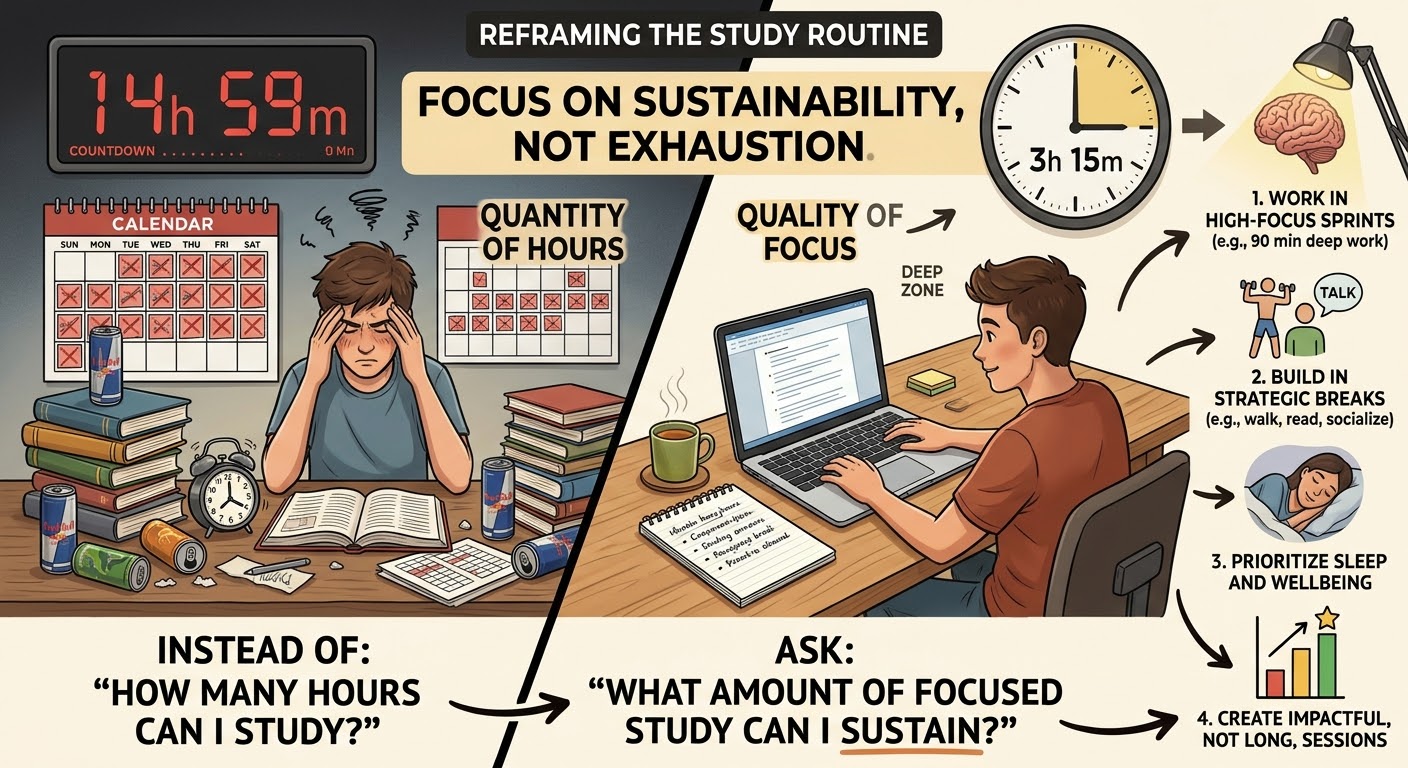
Instead of asking, “How many hours can I study every day?” a better question is:
“What amount of focused study can I realistically maintain without turning studying into a source of constant exhaustion?”
That answer is the foundation of a useful routine.
Start With Your Real Life, Not an Ideal Schedule
Before creating a timetable, observe your existing day.
Write down the commitments that cannot easily be moved:
- College or university hours
- Travel time
- Meals
- Sleep
- Family responsibilities
- Religious commitments
- Exercise or other activities
- Regular assignments and classes
What remains is your actual study window.
This simple exercise can prevent one of the biggest mistakes students make: creating a schedule that leaves no room for being human.
For example, if you return home in the afternoon, immediately scheduling a difficult three-hour study session may not be realistic. You may need time to eat, rest and mentally transition from college to home.
Perhaps your strongest study period begins later.
That is perfectly acceptable.
A productive routine does not have to resemble someone else's routine. The best study schedule is the one that works with your energy rather than constantly fighting it.

Give Every Study Session One Clear Purpose
“Study physics” is not a particularly useful task.
It is too broad. It gives you no clear starting point and no clear definition of completion.
Instead, turn vague intentions into specific outcomes.
Instead of:
Study physics.
Try:
Review the laws of motion, solve ten numerical problems and identify the questions I cannot solve independently.

Or instead of:
Study English.
Try:
Read one article, identify five unfamiliar words and write a short summary without looking back at the text.
The difference may appear small, but it changes the way your mind approaches the task.
A specific goal creates a finish line.
Once you know exactly what you are trying to accomplish, studying becomes less like sitting in front of a mountain of books and more like completing a series of manageable tasks.
Study According to Mental Energy
Time management is useful, but energy management is often more important.
Two hours at your most alert can be more productive than four hours spent fighting exhaustion.
Notice when your concentration is naturally strongest.
Are you more focused early in the morning? Do you become productive after a short afternoon rest? Does your concentration improve in the evening?

Use that information.
Place your most demanding subjects during your strongest concentration period and leave lighter activities—such as reviewing notes, organising material or recalling definitions—for periods when your mental energy is lower.
There is no universal “perfect” study time.
The important question is not whether successful students study at 5 a.m. or midnight.
It is:
When does your own mind work best, and are you using that period intelligently?
My Approach: Follow Focus, Not Just the Clock
One principle I have found particularly useful is allowing the subject that currently has my strongest mental attention to receive that attention fully.
If I am genuinely interested in mathematics at a particular moment, I do not necessarily force myself to stop simply because a timetable says that mathematics has received its allocated hour.
Likewise, if I sit down to study chemistry but my mind is completely unwilling to process it, forcing myself through several pages may create the appearance of productivity without producing much understanding.
This does not mean studying without discipline.
It means distinguishing between discipline and unnecessary rigidity.
The purpose of a study routine should ultimately be to prepare you for the examination, not to make every ordinary day look perfectly organised.
If your final examination requires you to understand a subject deeply, then the quality of your learning matters more than whether you followed an aesthetically perfect timetable.
This is why I prefer a precise but flexible routine over an exhausting one.
The routine provides direction. The focus determines where the deeper effort goes.
Use Active Learning Before You Close the Book
One of the most useful habits is also one of the simplest.
After studying a topic, do not immediately close the book and move on.
First, look at the topic carefully and make sure you understand what it is actually explaining. Then close the book and reproduce the concept from memory.
Ask yourself:
- What was the main idea?
- Why does it work this way?
- What steps or principles were involved?
- Could I explain it without looking?
This small act reveals whether you actually understood the topic or merely recognised the words on the page.
A topic that can be explained after the book is closed is far more securely learned than one that only looks familiar while the textbook remains open.
This is particularly useful before moving from one topic to another. A few minutes of recall can expose gaps immediately, while there is still time to correct them.

Do Not Leave Mistakes Behind
Another principle that has made a significant difference in my own study is treating mistakes as material that deserves repeated attention.
If I make the same mistake once, I correct it.
If I make it again, I revise it.
If I continue making it, I return to it until the correct method becomes almost automatic.
The objective is not simply to recognise the correct answer after seeing it.
The goal is to reach the point where the concept or method comes naturally.
This is especially important for formulas, numerical methods, definitions, grammatical structures and recurring conceptual errors.
A mistake that is corrected once may still return.
A mistake that is revisited repeatedly can eventually become a lesson that no longer needs conscious effort.
That is why I do not consider repeated revision of a difficult point a waste of time.
Sometimes the thing you need to revise most is precisely the thing you wish you could stop seeing.
Let Your Mind Revise in the Background
Not every useful moment of revision has to happen at a desk.
Sometimes, while using your phone, taking a break or simply enjoying your free time, a question from a test or an old mistake suddenly comes to mind.
Instead of immediately opening the book, I try to reconstruct the concept mentally.
I might think:
Yes, that topic worked this way because...
Or:
The mistake was happening because I was confusing this principle with that one.
This kind of mental recall is useful because it tests whether the knowledge exists beyond the physical presence of the textbook.
It also changes revision from something that happens only during formal study sessions into something that can occasionally occur naturally throughout the day.
Of course, this does not mean turning every moment of free time into a study session.
Free time should remain free time.
The point is simply to notice when the mind spontaneously retrieves something you have learned and use that moment as a brief mental check.

When You Cannot Study, Sometimes You Should Stop
There is another lesson that rigid study schedules often ignore:
Sometimes the right decision is not to study.
There are moments when you sit with a book open in front of you, read the same sentence several times and realise that nothing is entering your mind.
Instead of immediately calling yourself lazy, consider whether your mind is simply overloaded.
After prolonged concentration, mental fatigue can make further studying much less effective. When that happens, forcing more information into an already exhausted mind may produce very little useful learning.
A short break, some entertainment, a walk, conversation, sleep or another genuinely restorative activity can sometimes be more productive than another hour of ineffective reading.
The important distinction is between avoiding work and recognising mental exhaustion.
If you constantly avoid studying whenever something becomes difficult, that is a problem.
But if you have genuinely reached the point where your concentration has collapsed, refusing to rest can also become counterproductive.
A good routine should know when to push and when to pause.

Build Your Week Around Priorities
A daily timetable tells you what to do today.
A weekly system tells you whether you are actually moving forward.
At the beginning of each week, divide your academic workload into three categories:
Urgent
Tests, assignments, deadlines and topics that require immediate attention.
Important
Subjects and concepts that are essential but do not have an immediate deadline.
Maintenance
Revision, practice and short recall sessions that prevent previously learned material from fading.
This simple classification prevents every task from feeling equally urgent.
A student who treats everything as a priority eventually ends up prioritising nothing.
Instead, decide what deserves your strongest effort this week.

Schedule Revision Before You Need It
Many students think of revision as something that begins immediately before examinations.
That is one reason exam season becomes overwhelming.
If you wait until the end of the term to revisit everything, you are not really revising—you are attempting to rebuild information that has already faded.
A better approach is to make revision part of the original study process.
After learning a topic, return to it later.
A useful cycle is:
Understand → Close the book → Recall → Practise → Revisit → Test
The exact timing can vary according to the subject and your academic schedule, but the principle remains the same: information becomes more reliable when you repeatedly retrieve it rather than simply encountering it again.
Revision should therefore not be the final stage of studying.
It should begin from the moment learning begins.
Protect Your Attention
A student does not necessarily need a perfect study room.
They need fewer unnecessary interruptions.
Before beginning a session, remove whatever repeatedly steals your attention.
Put unnecessary notifications on silent. Close unrelated browser tabs. Keep only the books and materials required for the current task nearby.
If your phone constantly interrupts you, place it somewhere outside immediate reach.
The objective is not to eliminate technology.
Technology can be extremely useful for education.
The problem begins when every few minutes of study is interrupted by something that has nothing to do with the task.
Attention is a limited resource.
Spend it deliberately.

What to Do When You Fall Behind
Eventually, almost every student falls behind.
The important part is what happens next.
Do not respond to one missed day by creating an impossible catch-up schedule. That usually creates another failure, followed by another.
Instead, stop and assess.
Ask:
- What is genuinely essential?
- What can be postponed?
- Which topics are prerequisites for the others?
- What can realistically be completed today?
Then restart from there.
You do not need to recover an entire lost week in one night.
You need to recover the next useful hour.
That distinction can prevent a temporary setback from becoming a long-term pattern.

A Flexible Approach to Weekly Study Planning
A good study plan should give you direction without turning your week into a rigid timetable. Instead of filling every hour with tasks, use it to decide what deserves your attention and when you are most capable of giving it.
One thing worth understanding is that assigning a particular subject to an exact time does not always guarantee effective learning. Studying mathematics from 5:00 to 6:00 and chemistry from 6:00 to 7:00 may look organised on paper, but the mind does not always work according to fixed schedules. Sometimes, you feel naturally interested in a particular subject, and that is when your concentration is at its strongest. Rather than ignoring that interest simply because your timetable says otherwise, make use of it. Study the subject you feel most focused on, whenever possible, and allow yourself to explore it while your attention is genuinely there. Of course, weekly priorities and approaching deadlines still matter, but a little flexibility can make learning more enjoyable and effective. A timetable should guide your focus, not dictate it.
Step 1: Establish Your Real-Life Baseline
Before planning your week, write down your fixed commitments—classes, sleep, meals, travel, exercise, family responsibilities, and other unavoidable activities. This gives you a realistic picture of your actual study windows.
The goal is not to occupy every available hour. It is to identify where focused study can realistically fit without exhausting yourself.
Step 2: Categorize Your Weekly Priorities
At the beginning of each week, divide your academic workload into three categories:
- Urgent: Tests, assignments, approaching deadlines, and core topics that require immediate attention.
- Important: Essential subjects and concepts that contribute to long-term understanding but do not have an immediate deadline.
- Maintenance: Revision, practice, mistake correction, and short recall sessions that keep previously learned material fresh.
This makes it easier to decide what deserves your attention first instead of reacting to every task as though it were an emergency.
Avoid writing vague tasks such as “Study Physics.” Give the session a measurable purpose: “Solve 10 numerical problems,” “Recall the chapter without opening the book,” or “Identify and correct three recurring mistakes.”
This makes your study session easier to begin and gives you a clear way to know whether the session actually achieved something.
Step 3: End the Week With a Review
A weekly plan should not be treated as a verdict on your discipline. It is a tool that helps you understand how you actually study.
At the end of the week, ask yourself:
- ☐ What worked well this week?
- ☐ What repeatedly failed or felt unnecessarily rigid?
- ☐ Which subject received less attention than it needed?
- ☐ When was my concentration strongest?
- ☐ Did I use my highest-energy periods effectively?
- ☐ Which mistakes still need repeated revision?
- ☐ What should I change in next week's plan?
The purpose of this review is adjustment, not self-judgment. If a plan consistently fails, the answer is not always to demand more discipline from yourself. Sometimes the plan itself needs to become more realistic.
The Study Routine Should Serve You, Not Control You
A timetable is a tool, not a judge.
If you miss a session, your schedule has not “failed.” If you need to change your study hours because your college routine changes, adapting does not mean you are undisciplined.
A mature study routine has enough structure to keep you moving and enough flexibility to survive real life.
The purpose of discipline is not to make you feel guilty whenever you fall short.
It is to make returning easier.
Your timetable should evolve as you learn more about yourself.
Key Takeaways
A productive college study routine does not require an extraordinary amount of motivation.
It requires a realistic system.
- Build your schedule around your actual life.
- Set specific outcomes instead of vague study goals.
- Match difficult subjects with your strongest concentration periods.
- Follow genuine focus instead of forcing yourself through an arbitrary timetable.
- Close the book and recall the concept before moving on.
- Return to mistakes repeatedly until the correct method becomes natural.
- Use occasional mental recall during ordinary moments instead of making every break another formal study session.
- Recognise the difference between procrastination and genuine mental exhaustion.
- Plan your priorities weekly.
- Make revision part of your routine from the beginning.
- When you fall behind, restart with the next realistic task instead of trying to fix everything at once.
The Point Is Not to Study More. It Is to Learn Better.
A study routine is often presented as a battle against laziness: wake up earlier, sit longer, eliminate every distraction and force yourself to complete the timetable.
But learning is not simply a matter of how long a student remains seated in front of a book.
There is a point at which more hours stop producing more understanding.
There is also a difference between discipline and exhaustion.
Discipline means returning to the work that matters.
Exhaustion means continuing long after your mind has stopped processing it.
A good student needs to recognise the difference.
Perhaps the most useful question at the end of a study session is not:
“How many hours did I study?”
It is:
“What can I now explain, recall or solve that I could not before?”
If the answer is clear, the session had value.
If the answer is no, adding another hour may not be the solution. Perhaps the concept needs a different method. Perhaps the mistake needs repeated practice. Perhaps the mind simply needs to rest before it can learn again.
A productive routine is not a prison built around the clock.
It is a system that teaches you when to concentrate, when to revise, when to correct yourself and when to step away.
The strongest routine is not the one that controls every hour of your day. It is the one that makes learning stay with you after the hour is over.
Frequently Asked Questions
How many hours should a college student study every day?
There is no single number that works for every student. A better target is a realistic amount of focused study that can be maintained alongside classes, sleep, assignments and other responsibilities.
What should I do if I cannot follow my study timetable?
Do not immediately create an even stricter timetable. Find out why the plan failed, remove unrealistic tasks and restart with the next manageable study session.
Is it better to study according to a timetable or according to my mood?
A timetable provides structure, but your concentration also matters. A flexible routine can give you a planned direction while allowing you to spend more time on a subject when you are genuinely focused.
How can I remember what I study for longer?
Use active recall. After studying a topic, close the book and try to explain the idea, reproduce the important steps or solve a related problem without looking at the answer.
Should I study when I am mentally exhausted?
Not always. If you are genuinely unable to concentrate, a short break or proper rest may be more useful than forcing yourself through another ineffective study session. The key is to distinguish genuine exhaustion from simply wanting to avoid difficult work.
"Study smarter, not harder. Stay flexible, follow your focus, and don't let a timetable control your learning. You don't need to schedule every minute; you just need to make every focused moment count."







Comments 0
Sign in to join the conversation.
No comments yet. Be the first to say something.