

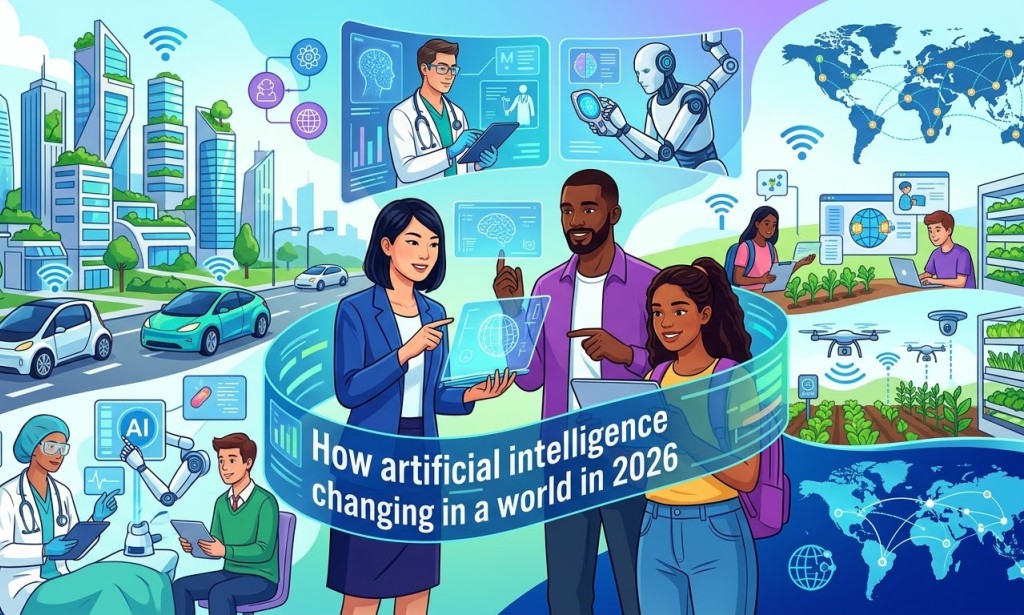
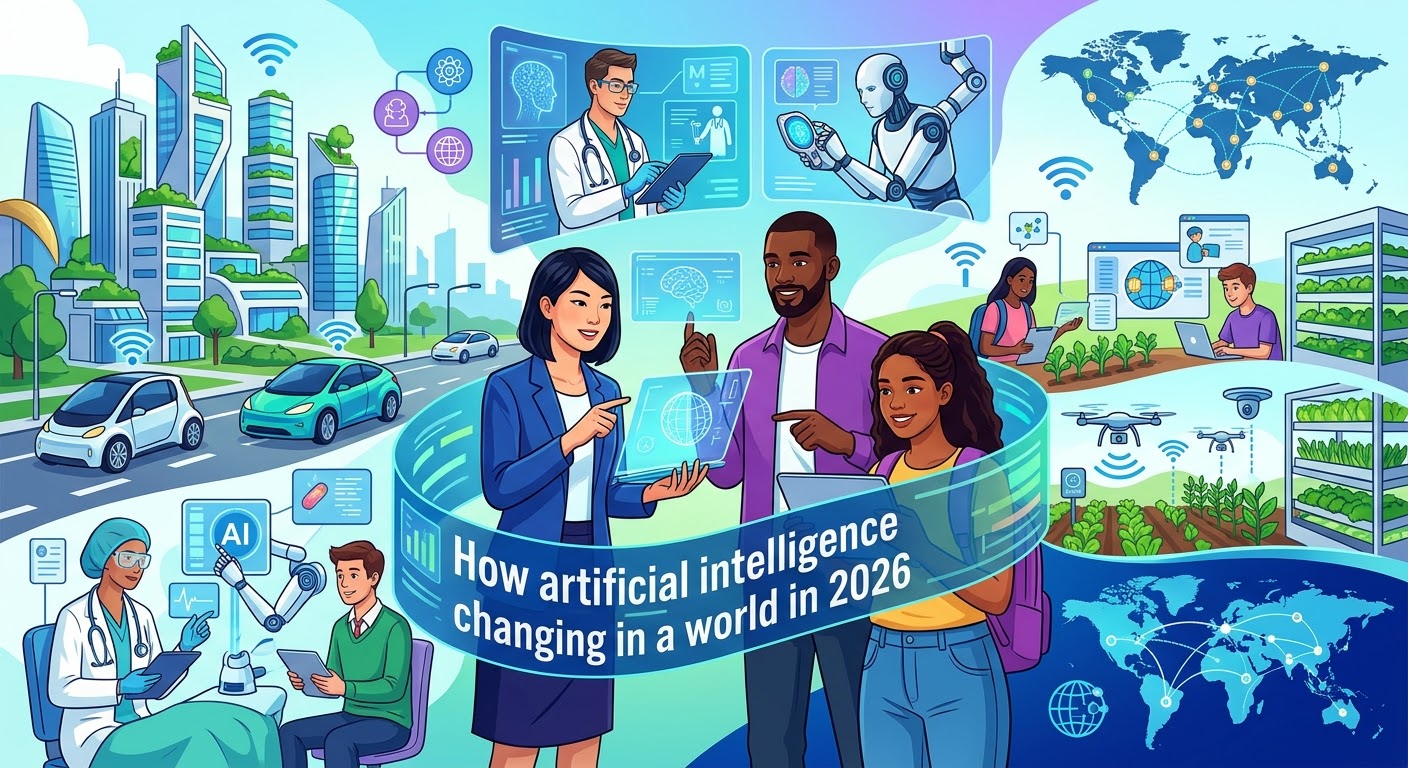
How Artificial Intelligence Is Changing the World in 2026
Introduction
Artificial Intelligence (AI) is one of the most important technologies in the modern world. In 2026, AI is transforming education, healthcare, business, and everyday life. It helps people complete tasks faster, solve problems, and access information more easily.
AI allows computers to perform tasks such as understanding language, analyzing data, recognizing images, and generating content. Although this technology offers many opportunities, it also presents challenges that people must understand.
1. What Is Artificial Intelligence?
Artificial Intelligence is a branch of computer science that develops systems capable of performing tasks that usually require human intelligence.
AI tools can answer questions, translate languages, summarize documents, create images, and assist with programming. Machine learning helps these systems identify patterns in data, while generative AI can produce new content.
However, AI is not always accurate. Its answers should be checked against reliable sources, especially when dealing with important information.
2. AI in Education
Artificial intelligence is changing how students learn and teachers prepare lessons. Students can use AI tools to understand difficult subjects, practice languages, and prepare for examinations.
Teachers can use these tools to develop lesson plans, create exercises, and explain complex topics in simpler language.
However, students should not depend entirely on AI or copy its answers without understanding them. AI works best as a learning assistant that supports independent thinking and creativity.
3. AI in Business

Businesses use AI to improve productivity, analyze information, and communicate with customers.
Small business owners can use AI to write product descriptions, prepare social media posts, and develop marketing ideas. Freelancers can use AI-assisted tools to organize projects and improve their writing.
These technologies can save time, but businesses must check the accuracy of AI-generated content and protect confidential information.
Human judgment, creativity, and customer relationships remain important for business success.
4. AI in Healthcare
AI is helping healthcare professionals analyze medical images, organize information, and support scientific research.
Specialized AI systems can assist trained professionals in identifying patterns that may be difficult to recognize quickly. Researchers can also use AI to examine scientific information and investigate possible treatments.
However, AI cannot replace qualified doctors. Medical decisions require professional knowledge and careful evaluation. Responsible use of AI also requires privacy protection and human supervision.
5. AI and Future Jobs
Artificial intelligence is changing the workplace by automating certain repetitive tasks and increasing demand for digital skills. Many businesses are using AI to improve productivity, manage information, and complete everyday activities more efficiently.
Some opportunities are developing in areas such as software engineering, data analysis, cybersecurity, and digital marketing. People who learn these skills may find new opportunities in the changing job market.
Although AI may change many jobs, it does not mean that every profession will disappear. Human creativity, communication, critical thinking, and problem-solving remain important in many industries.
Students can prepare for the future by learning digital skills and understanding how AI tools work. Professionals can also improve their abilities by exploring new technologies and adapting to workplace changes.
AI should be considered a tool that supports human work rather than a complete replacement for human intelligence.
6. AI in Everyday Life
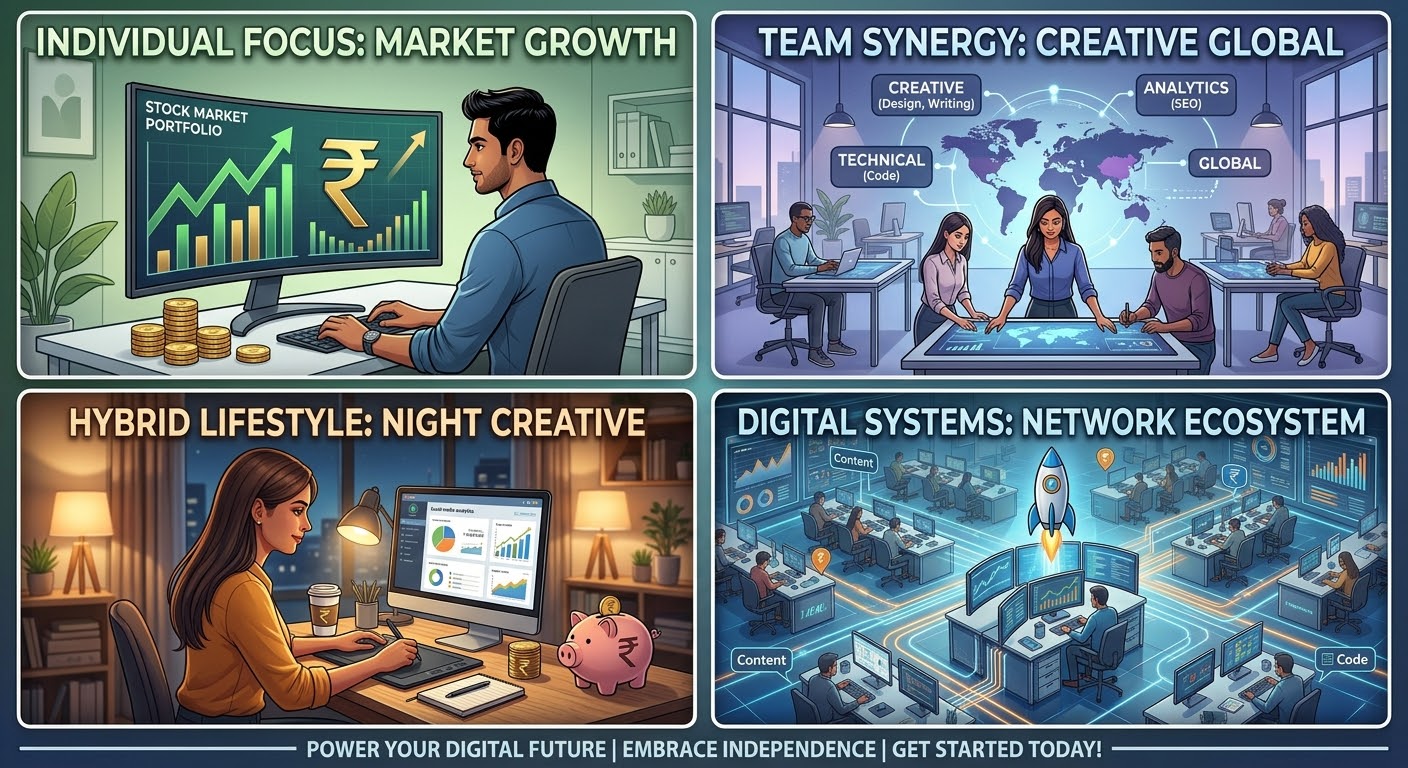
Artificial intelligence has become part of everyday life. People interact with AI through smartphones, navigation applications, translation tools, email filters, and online recommendation systems.
For example, streaming platforms recommend films and music according to users' interests. Navigation applications help people find routes and estimate travel times. Translation tools make communication easier between people who speak different languages.
AI assistants can also help users organize tasks, find information, and improve their writing. These applications save time and make certain activities more convenient.
However, users should not depend entirely on automated recommendations. AI systems may provide inaccurate information or suggest content that does not meet everyone's needs.
People should compare information from reliable sources and make independent decisions. Using AI carefully can make everyday activities easier while maintaining personal judgment and responsibility.
7. Challenges of Artificial Intelligence
Despite its benefits, artificial intelligence creates several challenges that require attention.
One major concern is misinformation. AI can generate convincing answers that contain incorrect facts. Users should verify important information before sharing it or making decisions based on it.
Privacy is another important issue. People should avoid sharing passwords, financial details, identity documents, or confidential information with AI services unless they understand the service's security and privacy protections.
AI systems can also produce biased results when their training data contains incomplete or unfair patterns. This may affect the quality and fairness of their decisions.
Another concern is the misuse of AI-generated images, videos, and text to spread misleading information. Responsible development, clear guidelines, and public awareness can help reduce these risks.
Governments, businesses, educational institutions, and technology developers all have responsibilities in promoting safe and ethical AI use.
By understanding these challenges, people can benefit from artificial intelligence while taking reasonable steps to protect themselves and others.
8. How to Prepare for an AI-Powered Future
Preparing for a future influenced by artificial intelligence begins with learning basic digital skills. People do not need to become computer scientists to benefit from AI technology.
Students can explore educational AI tools to understand difficult subjects, practice writing, and organize their studies. Professionals can use suitable tools to improve productivity and manage routine tasks.
Learning programming, digital marketing, data analysis, and cybersecurity may also create opportunities for people interested in technology-related careers.
However, technical knowledge alone is not enough. Communication, creativity, critical thinking, and problem-solving are equally valuable skills.
People should also learn how to check AI-generated information, protect personal data, and recognize the limitations of automated systems.
Continuous learning is important because technology changes rapidly. Individuals who remain curious, adaptable, and willing to develop new abilities can better prepare for future opportunities.
Responsible AI use can help people improve their skills without losing their independence or creativity.
Conclusion
Artificial intelligence is transforming education, business, healthcare, employment, and everyday life. It offers opportunities to improve productivity, support learning, and solve problems more efficiently.
However, challenges involving privacy, misinformation, biased results, and changing employment requirements must be addressed responsibly.
People can prepare for the future by developing digital skills, checking information carefully, and learning how to use AI effectively.
Artificial intelligence should support human intelligence, creativity, and decision-making rather than replace independent thinking. When used responsibly, it can contribute to innovation, education, and progress around the world.








Comments 0
Sign in to join the conversation.
No comments yet. Be the first to say something.